
architecture · folio
In one line: Your server addresses installs, not users. Each install gets a token (on iOS the FCM SDK maps the APNs token to an FCM token) and uploads it keyed by user + device; the backend fans out to every live token via FCM HTTP v1 (or APNs directly) and deletes the ones reported dead. What runs on arrival depends on message type, app state and platform.
Download PDF Print view LaTeX source
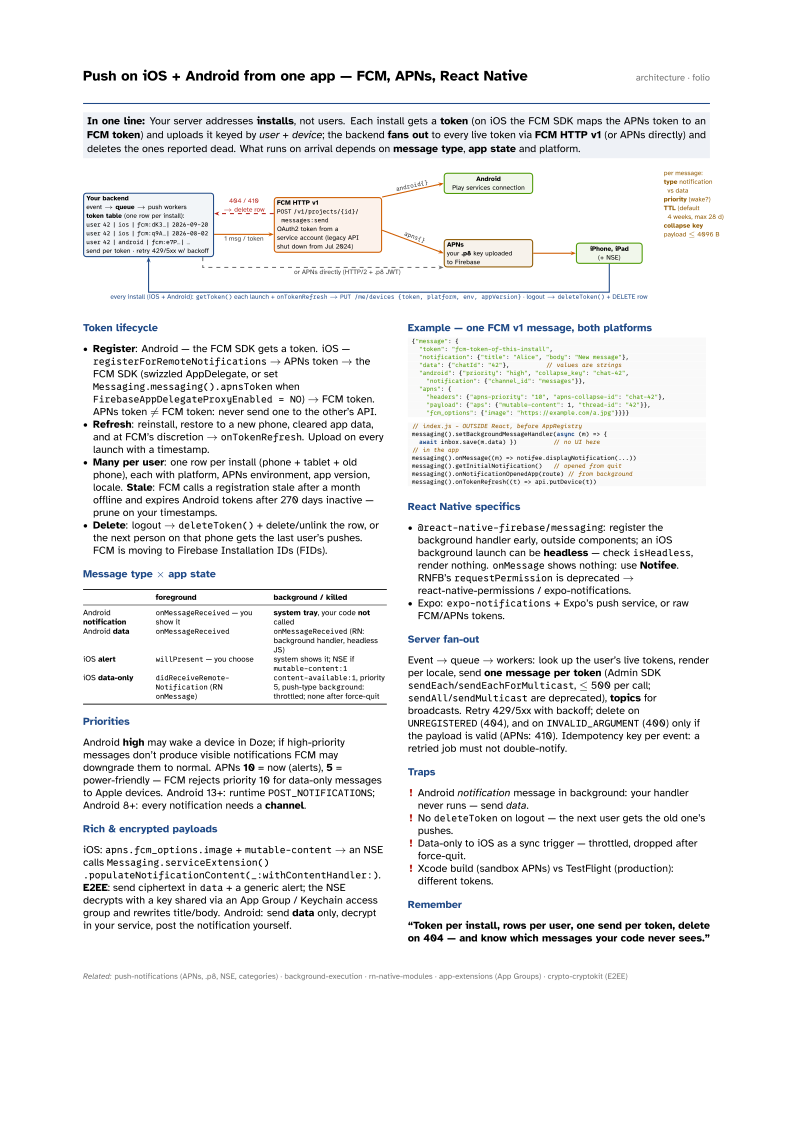

Token lifecycle
- Register: Android — the FCM SDK gets a token. iOS —
registerForRemoteNotifications→ APNs token → the FCM SDK (swizzled AppDelegate, or setMessaging.messaging().apnsTokenwhenFirebaseAppDelegateProxyEnabled = NO) → FCM token. APNs token ≠ FCM token: never send one to the other’s API. - Refresh: reinstall, restore to a new phone, cleared app data, and at FCM’s discretion →
onTokenRefresh. Upload on every launch with a timestamp. - Many per user: one row per install (phone + tablet + old phone), each with platform, APNs environment, app version, locale. Stale: FCM calls a registration stale after a month offline and expires Android tokens after 270 days inactive — prune on your timestamps.
- Delete: logout →
deleteToken()+ delete/unlink the row, or the next person on that phone gets the last user’s pushes. FCM is moving to Firebase Installation IDs (FIDs).
Message type × app state
| foreground | background / killed | |
|---|---|---|
| Android notification | onMessageReceived — you show it | system tray, your code not called |
| Android data | onMessageReceived | onMessageReceived (RN: background handler, headless JS) |
| iOS alert | willPresent — you choose | system shows it; NSE if mutable-content:1 |
| iOS data-only | didReceiveRemoteNotification (RN onMessage) | content-available:1, priority 5, push-type background: throttled; none after force-quit |
Priorities
Android high may wake a device in Doze; if high-priority messages don’t produce visible notifications FCM may downgrade them to normal. APNs 10 = now (alerts), 5 = power-friendly — FCM rejects priority 10 for data-only messages to Apple devices. Android 13+: runtime POST_NOTIFICATIONS; Android 8+: every notification needs a channel.
Rich & encrypted payloads
iOS: apns.fcm_options.image + mutable-content → an NSE calls Messaging.serviceExtension() .populateNotificationContent(_:withContentHandler:). E2EE: send ciphertext in data + a generic alert; the NSE decrypts with a key shared via an App Group / Keychain access group and rewrites title/body. Android: send data only, decrypt in your service, post the notification yourself.
Example — one FCM v1 message, both platforms
{"message": {
  "token": "fcm-token-of-this-install",
  "notification": {"title": "Alice", "body": "New message"},
  "data": {"chatId": "42"},          // values are strings
  "android": {"priority": "high", "collapse_key": "chat-42",
    "notification": {"channel_id": "messages"}},
  "apns": {
    "headers": {"apns-priority": "10", "apns-collapse-id": "chat-42"},
    "payload": {"aps": {"mutable-content": 1, "thread-id": "42"}},
    "fcm_options": {"image": "https://example.com/a.jpg"}}}}
// index.js - OUTSIDE React, before AppRegistry
messaging().setBackgroundMessageHandler(async (m) => {
await inbox.save(m.data) }) // no UI here
// in the app
messaging().onMessage((m) => notifee.displayNotification(...))
messaging().getInitialNotification() // opened from quit
messaging().onNotificationOpenedApp(route) // from background
messaging().onTokenRefresh((t) => api.putDevice(t))React Native specifics
@react-native-firebase/messaging: register the background handler early, outside components; an iOS background launch can be headless — checkisHeadless, render nothing.onMessageshows nothing: use Notifee. RNFB’srequestPermissionis deprecated → react-native-permissions / expo-notifications.- Expo:
expo-notifications+ Expo’s push service, or raw FCM/APNs tokens.
Server fan-out
Event → queue → workers: look up the user’s live tokens, render per locale, send one
message per token (Admin SDK sendEach/sendEachForMulticast, ≤ 500 per call; sendAll/sendMulticast are deprecated), topics for broadcasts. Retry 429/5xx with backoff; delete on UNREGISTERED (404), and on INVALID_ARGUMENT (400) only if the payload is valid (APNs: 410). Idempotency key per event: a retried job must not double-notify.
Traps
- Android notification message in background: your handler never runs — send data.
- No
deleteTokenon logout — the next user gets the old one’s pushes. - Data-only to iOS as a sync trigger — throttled, dropped after force-quit.
- Xcode build (sandbox APNs) vs TestFlight (production): different tokens.