
c · folio
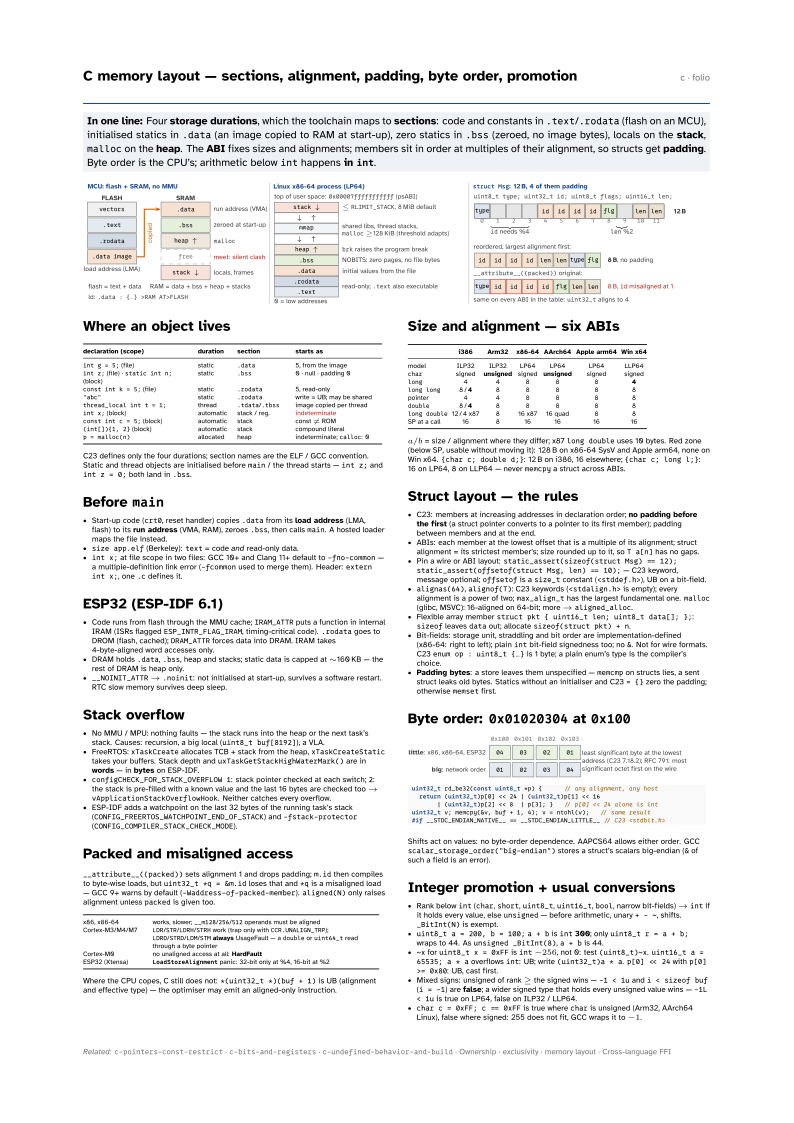
In one line: Four storage durations, which the toolchain maps to sections: code and
constants in .text/.rodata (flash on an MCU), initialised statics in .data (an
image copied to RAM at start-up), zero statics in .bss (zeroed, no image bytes), locals on
the stack, malloc on the heap. The ABI fixes sizes and
alignments; members sit in order at multiples of their alignment, so structs get
padding. Byte order is the CPU’s; arithmetic below int happens in int.
Download PDF Print view LaTeX source

Where an object lives
| declaration (scope) | duration | section | starts as |
|---|---|---|---|
int g = 5; (file) | static | .data | 5, from the image |
int z; (file) · static int n; (block) | static | .bss | 0 · null · padding 0 |
const int k = 5; (file) | static | .rodata | 5, read-only |
"abc" | static | .rodata | write = UB; may be shared |
thread_local int t = 1; | thread | .tdata/.tbss | image copied per thread |
int x; (block) | automatic | stack / reg. | indeterminate |
const int c = 5; (block) | automatic | stack | const ≠ ROM |
(int[]){1, 2} (block) | automatic | stack | compound literal |
p = malloc(n) | allocated | heap | indeterminate; calloc: 0 |
C23 defines only the four durations; section names are the ELF / GCC convention. Static and thread objects are initialised before main / the thread starts — int z; and int z = 0; both land in .bss.
Before main
- Start-up code (
crt0, reset handler) copies.datafrom its load address (LMA, flash) to its run address (VMA, RAM), zeroes.bss, then callsmain. A hosted loader maps the file instead. size app.elf(Berkeley):text= code and read-only data.int x;at file scope in two files: GCC 10+ and Clang 11+ default to-fno-common— a multiple-definition link error (-fcommonused to merge them). Header:extern int x;, one.cdefines it.
ESP32 (ESP-IDF 6.1)
- Code runs from flash through the MMU cache;
IRAM_ATTRputs a function in internal IRAM (ISRs flaggedESP_INTR_FLAG_IRAM, timing-critical code)..rodatagoes to DROM (flash, cached);DRAM_ATTRforces data into DRAM. IRAM takes 4-byte-aligned word accesses only. - DRAM holds
.data,.bss, heap and stacks; static data is capped at ∼160 KB — the rest of DRAM is heap only. __NOINIT_ATTR→.noinit: not initialised at start-up, survives a software restart. RTC slow memory survives deep sleep.
Stack overflow
- No MMU / MPU: nothing faults — the stack runs into the heap or the next task’s stack. Causes: recursion, a big local (
uint8_t buf[8192]), a VLA. - FreeRTOS:
xTaskCreateallocates TCB + stack from the heap,xTaskCreateStatictakes your buffers. Stack depth anduxTaskGetStackHighWaterMark()are in words — in bytes on ESP-IDF. configCHECK_FOR_STACK_OVERFLOW 1: stack pointer checked at each switch;2: the stack is pre-filled with a known value and the last 16 bytes are checked too →vApplicationStackOverflowHook. Neither catches every overflow.- ESP-IDF adds a watchpoint on the last 32 bytes of the running task’s stack (
CONFIG_FREERTOS_WATCHPOINT_END_OF_STACK) and-fstack-protector(CONFIG_COMPILER_STACK_CHECK_MODE).
Packed and misaligned access
__attribute__((packed)) sets alignment 1 and drops padding; m.id then compiles to byte-wise loads, but uint32_t *q = &m.id loses that and *q is a misaligned load — GCC 9+ warns by default (-Waddress-of-packed-member). aligned(N) only raises alignment unless packed is given too.
| x86, x86-64 | works, slower; __m128/256/512 operands must be aligned |
| Cortex-M3/M4/M7 | LDR/STR/LDRH/STRH work (trap only with CCR.UNALIGN_TRP);
LDRD/STRD/LDM/STM always UsageFault — a double or
uint64_t read through a byte pointer |
| Cortex-M0 | no unaligned access at all: HardFault |
| ESP32 (Xtensa) | LoadStoreAlignment panic: 32-bit only at %4, 16-bit at %2 |
Where the CPU copes, C still does not: *(uint32_t *)(buf + 1) is UB (alignment and effective type) — the optimiser may emit an aligned-only instruction.
Size and alignment — six ABIs
| i386 | Arm32 | x86-64 | AArch64 | Apple arm64 | Win x64 | |
|---|---|---|---|---|---|---|
| model | ILP32 | ILP32 | LP64 | LP64 | LP64 | LLP64 |
char | signed | unsigned | signed | unsigned | signed | signed |
long | 4 | 4 | 8 | 8 | 8 | 4 |
long long | 8 / 4 | 8 | 8 | 8 | 8 | 8 |
| pointer | 4 | 4 | 8 | 8 | 8 | 8 |
double | 8 / 4 | 8 | 8 | 8 | 8 | 8 |
long double | 12 / 4 x87 | 8 | 16 x87 | 16 quad | 8 | 8 |
| SP at a call | 16 | 8 | 16 | 16 | 16 | 16 |
a / b = size / alignment where they differ; x87 long double uses 10 bytes. Red zone (below SP, usable without moving it): 128 B on x86-64 SysV and Apple arm64, none on Win x64. {char c; double d;}: 12 B on i386, 16 elsewhere; {char c; long l;}: 16 on LP64, 8 on LLP64 — never memcpy a struct across ABIs.
Struct layout — the rules
- C23: members at increasing addresses in declaration order; no padding before the first (a struct pointer converts to a pointer to its first member); padding between members and at the end.
- ABIs: each member at the lowest offset that is a multiple of its alignment; struct alignment = its strictest member’s; size rounded up to it, so
T a[n]has no gaps. - Pin a wire or ABI layout:
static_assert(sizeof(struct Msg) == 12);static_assert(offsetof(struct Msg, len) == 10);— C23 keyword, message optional;offsetofis asize_tconstant (<stddef.h>), UB on a bit-field. alignas(64),alignof(T): C23 keywords (<stdalign.h>is empty); every alignment is a power of two;max_align_thas the largest fundamental one.malloc(glibc, MSVC): 16-aligned on 64-bit; more →aligned_alloc.- Flexible array member
struct pkt { uint16_t len; uint8_t data[]; };:sizeofleavesdataout; allocatesizeof(struct pkt) + n. - Bit-fields: storage unit, straddling and bit order are implementation-defined (x86-64: right to left); plain
intbit-field signedness too; no&. Not for wire formats. C23enum op : uint8_t {…}is 1 byte; a plain enum’s type is the compiler’s choice. - Padding bytes: a store leaves them unspecified —
memcmpon structs lies, a sent struct leaks old bytes. Statics without an initialiser and C23= {}zero the padding; otherwisememsetfirst.
Byte order: 0x01020304 at 0x100

uint32_t rd_be32(const uint8_t *p) {      // any alignment, any host
  return (uint32_t)p[0] << 24 | (uint32_t)p[1] << 16
       | (uint32_t)p[2] << 8  | p[3]; }   // p[0] << 24 alone is int
uint32_t v; memcpy(&v, buf + 1, 4); v = ntohl(v);   // same result
#if __STDC_ENDIAN_NATIVE__ == __STDC_ENDIAN_LITTLE__ // C23 <stdbit.h>
Shifts act on values: no byte-order dependence. AAPCS64 allows either order. GCC scalar_storage_order("big-endian") stores a struct’s scalars big-endian (& of such a field is an error).
Integer promotion + usual conversions
- Rank below
int(char,short,uint8_t,uint16_t,bool, narrow bit-fields) →intif it holds every value, elseunsigned— before arithmetic, unary+ - ~, shifts._BitInt(N)is exempt. uint8_t a = 200, b = 100;a + bisint300; onlyuint8_t r = a + b;wraps to 44. Asunsigned _BitInt(8),a + bis 44.~xforuint8_t x = 0xFFisint-256, not 0: test(uint8_t)~x.uint16_t a = 65535; a * aoverflowsint: UB; write(uint32_t)a * a.p[0] << 24withp[0] >= 0x80: UB, cast first.- Mixed signs: unsigned of rank ≥ the signed wins —
-1 < 1uandi < sizeof buf(i = -1) are false; a wider signed type that holds every unsigned value wins —-1L < 1uis true on LP64, false on ILP32 / LLP64. char c = 0xFF; c == 0xFFis true wherecharis unsigned (Arm32, AArch64 Linux), false where signed: 255 does not fit, GCC wraps it to -1.