
c · folio
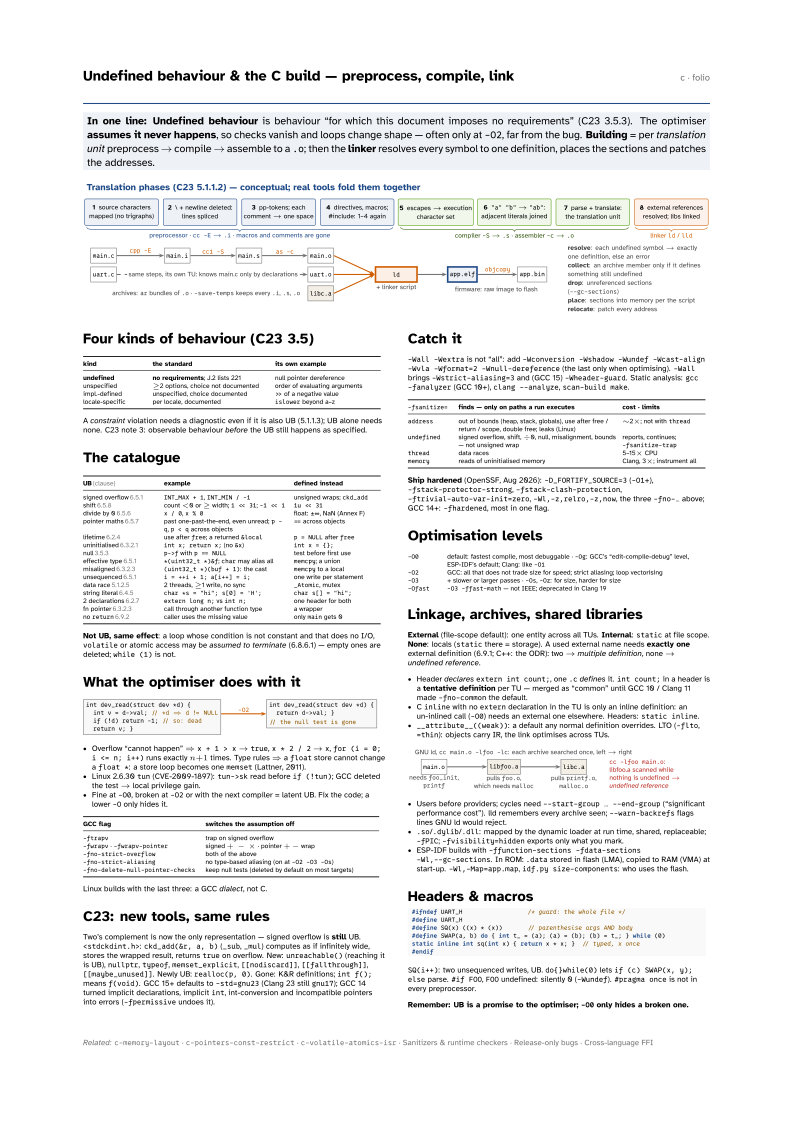
In one line: Undefined behaviour is behaviour “for which this document imposes no
requirements” (C23 3.5.3). The optimiser assumes it never happens, so checks vanish and
loops change shape — often only at -O2, far from the bug. Building = per
translation unit preprocess → compile → assemble to a .o; then the linker
resolves every symbol to one definition, places the sections and patches the addresses.
Download PDF Print view LaTeX source

Four kinds of behaviour (C23 3.5)
| kind | the standard | its own example |
|---|---|---|
| undefined | no requirements; J.2 lists 221 | null pointer dereference |
| unspecified | ≥2 options, choice not documented | order of evaluating arguments |
| impl.-defined | unspecified, choice documented | >> of a negative value |
| locale-specific | per locale, documented | islower beyond a–z |
A constraint violation needs a diagnostic even if it is also UB (5.1.1.3); UB alone needs none. C23 note 3: observable behaviour before the UB still happens as specified.
The catalogue
| UB (clause) | example | defined instead |
|---|---|---|
| signed overflow 6.5.1 | INT_MAX + 1, INT_MIN / -1 | unsigned wraps; ckd_add |
| shift 6.5.8 | count <0 or ≥ width; 1 << 31; -1 << 1 | 1u << 31 |
| divide by 0 6.5.6 | x / 0, x % 0 | float: ±∞, NaN (Annex F) |
| pointer maths 6.5.7 | past one-past-the-end, even unread; p - q, p < q across objects | == across objects |
| lifetime 6.2.4 | use after free; a returned &local | p = NULL after free |
| uninitialised 6.3.2.1 | int x; return x; (no &x) | int x = {}; |
| null 3.5.3 | p->f with p == NULL | test before first use |
| effective type 6.5.1 | *(uint32_t *)&f; char may alias all | memcpy; a union |
| misaligned 6.3.2.3 | (uint32_t *)(buf + 1): the cast | memcpy to a local |
| unsequenced 6.5.1 | i = ++i + 1; a[i++] = i; | one write per statement |
| data race 5.1.2.5 | 2 threads, ≥1 write, no sync | _Atomic, mutex |
| string literal 6.4.5 | char *s = "hi"; s[0] = 'H'; | char s[] = "hi"; |
| 2 declarations 6.2.7 | extern long n; vs int n; | one header for both |
| fn pointer 6.3.2.3 | call through another function type | a wrapper |
no return 6.9.2 | caller uses the missing value | only main gets 0 |
Not UB, same effect: a loop whose condition is not constant and that does no I/O, volatile or atomic access may be assumed to terminate (6.8.6.1) — empty ones are deleted; while (1) is not.
What the optimiser does with it

- Overflow “cannot happen” ⇒
x + 1 > x→true,x * 2 / 2→x,for (i = 0; i <= n; i++)runs exactly n+1 times. Type rules ⇒ afloatstore cannot change afloat *: a store loop becomes onememset(Lattner, 2011). - Linux 2.6.30
tun(CVE-2009-1897):tun->skread beforeif (!tun); GCC deleted the test → local privilege gain. - Fine at
-O0, broken at-O2or with the next compiler = latent UB. Fix the code; a lower-Oonly hides it.
| GCC flag | switches the assumption off |
|---|---|
-ftrapv | trap on signed overflow |
-fwrapv · -fwrapv-pointer | signed + - × · pointer + - wrap |
-fno-strict-overflow | both of the above |
-fno-strict-aliasing | no type-based aliasing (on at -O2 -O3 -Os) |
-fno-delete-null-pointer-checks | keep null tests (deleted by default on most targets) |
Linux builds with the last three: a GCC dialect, not C.
C23: new tools, same rules
Two’s complement is now the only representation — signed overflow is still UB. <stdckdint.h>: ckd_add(&r, a, b) (_sub, _mul) computes as if infinitely wide, stores the wrapped result, returns true on overflow. New: unreachable() (reaching it is UB), nullptr, typeof, memset_explicit, [[nodiscard]], [[fallthrough]], [[maybe_unused]]. Newly UB: realloc(p, 0). Gone: K&R definitions; int f(); means f(void). GCC 15+ defaults to -std=gnu23 (Clang 23 still gnu17); GCC 14 turned implicit declarations, implicit int, int-conversion and incompatible pointers into errors (-fpermissive undoes it).
Catch it
-Wall -Wextra is not “all”: add -Wconversion -Wshadow -Wundef -Wcast-align -Wvla
-Wformat=2 -Wnull-dereference (the last only when optimising). -Wall brings -Wstrict-aliasing=3 and (GCC 15) -Wheader-guard. Static analysis: gcc -fanalyzer (GCC 10+), clang --analyze, scan-build make.
-fsanitize= | finds — only on paths a run executes | cost · limits |
|---|---|---|
address | out of bounds (heap, stack, globals), use after free / return / scope, double free; leaks (Linux) | ∼2×; not with thread |
undefined | signed overflow, shift, ÷0, null, misalignment, bounds — not unsigned wrap | reports, continues; -fsanitize-trap |
thread | data races | 5–15× CPU |
memory | reads of uninitialised memory | Clang, 3×; instrument all |
Ship hardened (OpenSSF, Aug 2026): -D_FORTIFY_SOURCE=3 (-O1+), -fstack-protector-strong, -fstack-clash-protection, -ftrivial-auto-var-init=zero, -Wl,-z,relro,-z,now, the three -fno-… above; GCC 14+: -fhardened, most in one flag.
Optimisation levels
-O0 | default: fastest compile, most debuggable · -Og: GCC’s “edit-compile-debug” level, ESP-IDF’s default; Clang: like -O1 |
-O2 | GCC: all that does not trade size for speed; strict aliasing; loop vectorising |
-O3 | + slower or larger passes · -Os, -Oz: for size, harder for size |
-Ofast | -O3 -ffast-math — not IEEE; deprecated in Clang 19 |
Linkage, archives, shared libraries
External (file-scope default): one entity across all TUs. Internal: static at file scope. None: locals (static there = storage). A used external name needs exactly one external definition (6.9.1; C++: the ODR): two → multiple
definition, none → undefined reference.
- Header declares
extern int count;, one.cdefines it.int count;in a header is a tentative definition per TU — merged as “common” until GCC 10 / Clang 11 made-fno-commonthe default. - C
inlinewith noexterndeclaration in the TU is only an inline definition: an un-inlined call (-O0) needs an external one elsewhere. Headers:static inline. __attribute__((weak)): a default any normal definition overrides. LTO (-flto,=thin): objects carry IR, the link optimises across TUs.

- Users before providers; cycles need
--start-group … --end-group(“significant performance cost”). lld remembers every archive seen;--warn-backrefsflags lines GNU ld would reject. .so/.dylib/.dll: mapped by the dynamic loader at run time, shared, replaceable;-fPIC;-fvisibility=hiddenexports only what you mark.- ESP-IDF builds with
-ffunction-sections -fdata-sections -Wl,--gc-sections. In ROM:.datastored in flash (LMA), copied to RAM (VMA) at start-up.-Wl,-Map=app.map,idf.py size-components: who uses the flash.
Headers & macros
#ifndef UART_H                  /* guard: the whole file */
#define UART_H
#define SQ(x) ((x) * (x))       // parenthesise args AND body
#define SWAP(a, b) do { int t_ = (a); (a) = (b); (b) = t_; } while (0)
static inline int sq(int x) { return x * x; }  // typed, x once
#endifSQ(i++): two unsequenced writes, UB. do{}while(0) lets if (c) SWAP(x, y); else parse. #if FOO, FOO undefined: silently 0 (-Wundef). #pragma once is not in every preprocessor.
Remember: UB is a promise to the optimiser; -O0 only hides a broken one.