
crypto · folio
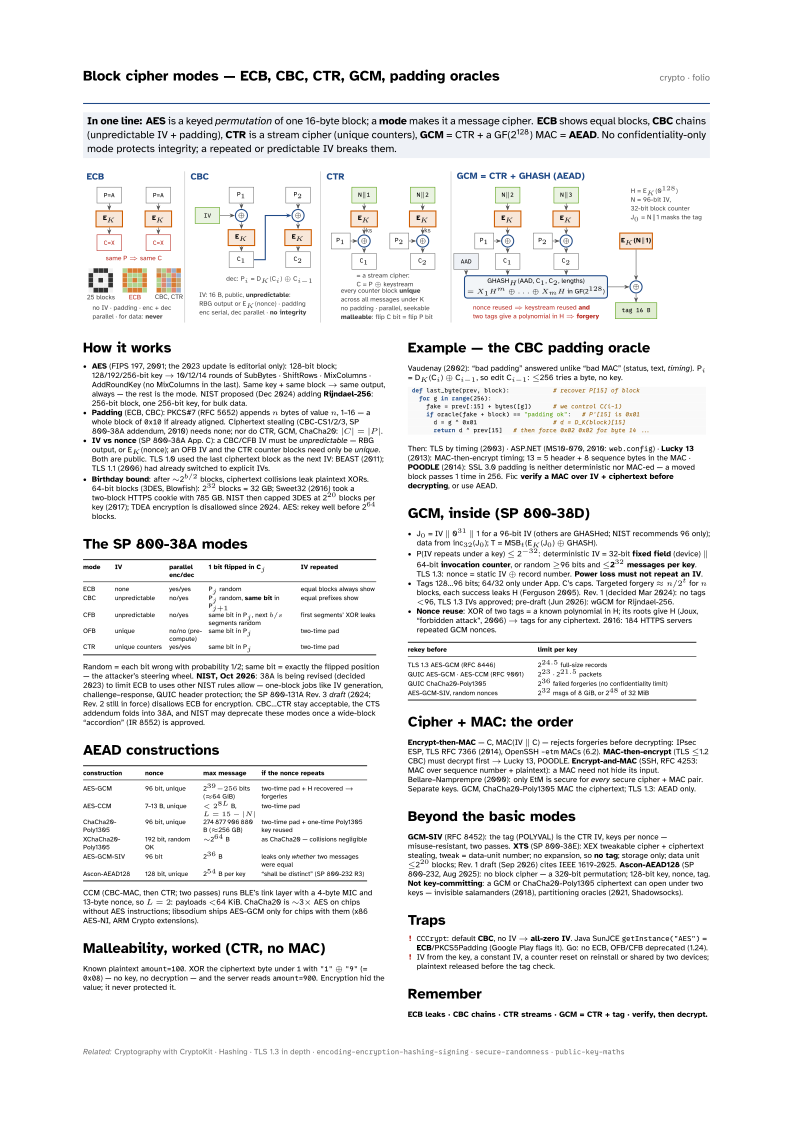
In one line: AES is a keyed permutation of one 16-byte block; a mode makes it a message cipher. ECB shows equal blocks, CBC chains (unpredictable IV + padding), CTR is a stream cipher (unique counters), GCM = CTR + a GF(2128) MAC = AEAD. No confidentiality-only mode protects integrity; a repeated or predictable IV breaks them.
Download PDF Print view LaTeX source

How it works
- AES (FIPS 197, 2001; the 2023 update is editorial only): 128-bit block; 128/192/256-bit key → 10/12/14 rounds of SubBytes · ShiftRows · MixColumns · AddRoundKey (no MixColumns in the last). Same key + same block → same output, always — the rest is the mode. NIST proposed (Dec 2024) adding Rijndael-256: 256-bit block, one 256-bit key, for bulk data.
- Padding (ECB, CBC): PKCS#7 (RFC 5652) appends n bytes of value n, 1–16 — a whole block of
0x10if already aligned. Ciphertext stealing (CBC-CS1/2/3, SP 800-38A addendum, 2010) needs none; nor do CTR, GCM, ChaCha20: |C| = |P|. - IV vs nonce (SP 800-38A App. C): a CBC/CFB IV must be unpredictable — RBG output, or EK(nonce); an OFB IV and the CTR counter blocks need only be unique. Both are public. TLS 1.0 used the last ciphertext block as the next IV: BEAST (2011); TLS 1.1 (2006) had already switched to explicit IVs.
- Birthday bound: after ∼2b/2 blocks, ciphertext collisions leak plaintext XORs. 64-bit blocks (3DES, Blowfish): 232 blocks = 32 GB; Sweet32 (2016) took a two-block HTTPS cookie with 785 GB. NIST then capped 3DES at 220 blocks per key (2017); TDEA encryption is disallowed since 2024. AES: rekey well before 264 blocks.
The SP 800-38A modes
| mode | IV | parallel enc/dec | 1 bit flipped in Cj | IV repeated |
|---|---|---|---|---|
| ECB | none | yes/yes | Pj random | equal blocks always show |
| CBC | unpredictable | no/yes | Pj random, same bit in Pj+1 | equal prefixes show |
| CFB | unpredictable | no/yes | same bit in Pj, next b/s segments random | first segments’ XOR leaks |
| OFB | unique | no/no (precompute) | same bit in Pj | two-time pad |
| CTR | unique counters | yes/yes | same bit in Pj | two-time pad |
Random = each bit wrong with probability 1/2; same bit = exactly the flipped position — the attacker’s steering wheel. NIST, Oct 2026: 38A is being revised (decided 2023) to limit ECB to uses other NIST rules allow — one-block jobs like IV generation, challenge–response, QUIC header protection; the SP 800-131A Rev. 3 draft (2024; Rev. 2 still in force) disallows ECB for encryption. CBC…CTR stay acceptable, the CTS addendum folds into 38A, and NIST may deprecate these modes once a wide-block “accordion” (IR 8552) is approved.
AEAD constructions
| construction | nonce | max message | if the nonce repeats |
|---|---|---|---|
| AES-GCM | 96 bit, unique | 239-256 bits (≈64 GiB) | two-time pad + H recovered → forgeries |
| AES-CCM | 7–13 B, unique | <28L B, L = 15 - |N| | two-time pad |
| ChaCha20-Poly1305 | 96 bit, unique | 274 877 906 880 B (≈256 GB) | two-time pad + one-time Poly1305 key reused |
| XChaCha20-Poly1305 | 192 bit, random OK | ∼264 B | as ChaCha20 — collisions negligible |
| AES-GCM-SIV | 96 bit | 236 B | leaks only whether two messages were equal |
| Ascon-AEAD128 | 128 bit, unique | 254 B per key | “shall be distinct” (SP 800-232 R3) |
CCM (CBC-MAC, then CTR; two passes) runs BLE’s link layer with a 4-byte MIC and 13-byte nonce, so L = 2: payloads <64 KiB. ChaCha20 is ∼3× AES on chips without AES instructions; libsodium ships AES-GCM only for chips with them (x86 AES-NI, ARM Crypto extensions).
Malleability, worked (CTR, no MAC)
Known plaintext amount=100. XOR the ciphertext byte under 1 with "1" ⊕ "9" (= 0x08) — no key, no decryption — and the server reads amount=900. Encryption hid the value; it never protected it.
Example — the CBC padding oracle
Vaudenay (2002): “bad padding” answered unlike “bad MAC” (status, text, timing). Pi = DK(Ci) ⊕ Ci-1, so edit Ci-1: ≤256 tries a byte, no key.
def last_byte(prev, block):            # recover P[15] of block
  for g in range(256):
    fake = prev[:15] + bytes([g])      # we control C(i-1)
    if oracle(fake + block) == "padding ok":   # P'[15] is 0x01
      d = g ^ 0x01                     # d = D_K(block)[15]
      return d ^ prev[15]   # then force 0x02 0x02 for byte 14 ...
Then: TLS by timing (2003) · ASP.NET (MS10-070, 2010: web.config) · Lucky 13 (2013): MAC-then-encrypt timing; 13 = 5 header + 8 sequence bytes in the MAC · POODLE (2014): SSL 3.0 padding is neither deterministic nor MAC-ed — a moved block passes 1 time in 256. Fix: verify a MAC over IV + ciphertext before decrypting, or use AEAD.
GCM, inside (SP 800-38D)
- J0 = IV ‖ 031 ‖ 1 for a 96-bit IV (others are GHASHed; NIST recommends 96 only); data from inc32(J0); T = MSBt(EK(J0) ⊕ GHASH).
- P(IV repeats under a key) ≤ 2-32: deterministic IV = 32-bit fixed field (device) ‖ 64-bit invocation counter, or random ≥96 bits and ≤232 messages per key. TLS 1.3: nonce = static IV ⊕ record number. Power loss must not repeat an IV.
- Tags 128…96 bits; 64/32 only under App. C’s caps. Targeted forgery ≈n/2t for n blocks, each success leaks H (Ferguson 2005). Rev. 1 (decided Mar 2024): no tags <96, TLS 1.3 IVs approved; pre-draft (Jun 2026): wGCM for Rijndael-256.
- Nonce reuse: XOR of two tags = a known polynomial in H; its roots give H (Joux, “forbidden attack”, 2006) → tags for any ciphertext. 2016: 184 HTTPS servers repeated GCM nonces.
| rekey before | limit per key |
|---|---|
| TLS 1.3 AES-GCM (RFC 8446) | 224.5 full-size records |
| QUIC AES-GCM · AES-CCM (RFC 9001) | 223 · 221.5 packets |
| QUIC ChaCha20-Poly1305 | 236 failed forgeries (no confidentiality limit) |
| AES-GCM-SIV, random nonces | 232 msgs of 8 GiB, or 248 of 32 MiB |
Cipher + MAC: the order
Encrypt-then-MAC — C, MAC(IV ‖ C) — rejects forgeries before decrypting: IPsec ESP, TLS RFC 7366 (2014), OpenSSH -etm MACs (6.2). MAC-then-encrypt (TLS ≤1.2 CBC) must decrypt first → Lucky 13, POODLE. Encrypt-and-MAC (SSH, RFC 4253: MAC over sequence number + plaintext): a MAC need not hide its input. Bellare–Namprempre (2000): only EtM is secure for every secure cipher + MAC pair. Separate keys. GCM, ChaCha20-Poly1305 MAC the ciphertext; TLS 1.3: AEAD only.
Beyond the basic modes
GCM-SIV (RFC 8452): the tag (POLYVAL) is the CTR IV, keys per nonce — misuse-resistant, two passes. XTS (SP 800-38E): XEX tweakable cipher + ciphertext stealing, tweak = data-unit number; no expansion, so no tag; storage only; data unit ≤220 blocks; Rev. 1 draft (Sep 2026) cites IEEE 1619-2025. Ascon-AEAD128 (SP 800-232, Aug 2025): no block cipher — a 320-bit permutation; 128-bit key, nonce, tag. Not key-committing: a GCM or ChaCha20-Poly1305 ciphertext can open under two keys — invisible salamanders (2018), partitioning oracles (2021, Shadowsocks).
Traps
CCCrypt: default CBC, no IV → all-zero IV. Java SunJCEgetInstance("AES")= ECB/PKCS5Padding (Google Play flags it). Go: no ECB, OFB/CFB deprecated (1.24).- IV from the key, a constant IV, a counter reset on reinstall or shared by two devices; plaintext released before the tag check.