
crypto · folio
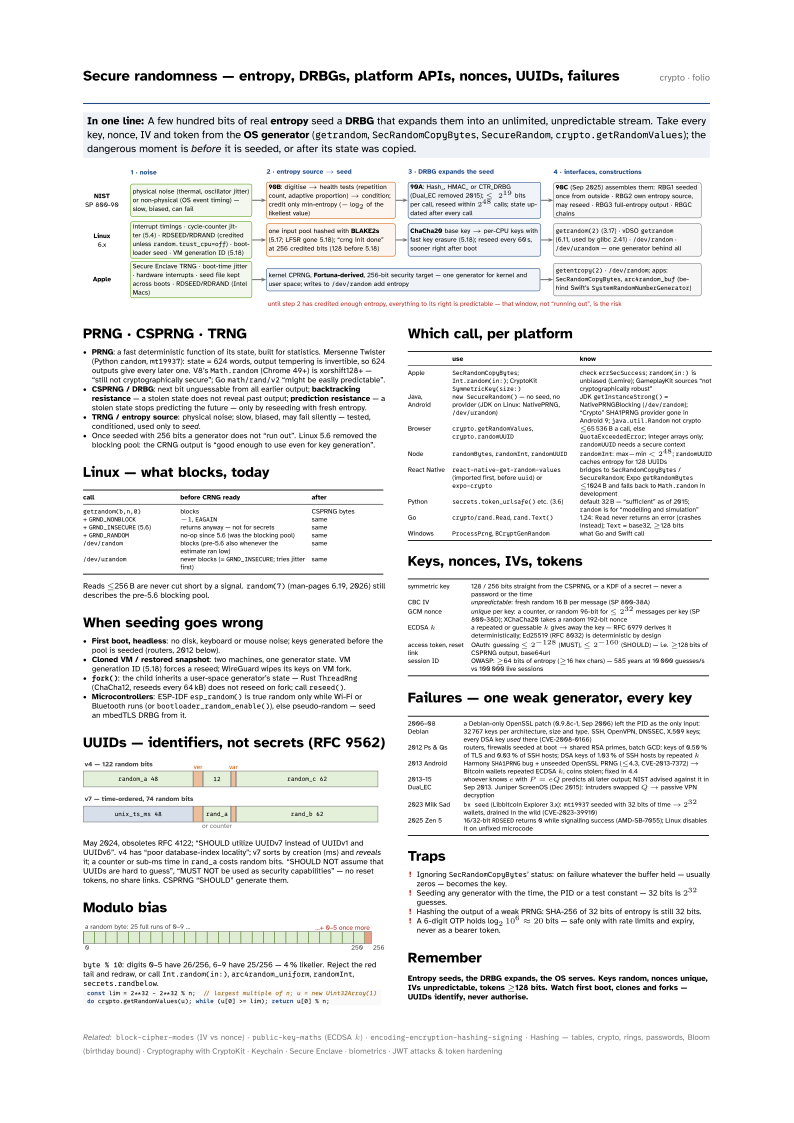
In one line: A few hundred bits of real entropy seed a DRBG that expands them into an
unlimited, unpredictable stream. Take every key, nonce, IV and token from the OS generator
(getrandom, SecRandomCopyBytes, SecureRandom, crypto.getRandomValues); the
dangerous moment is before it is seeded, or after its state was copied.
Download PDF Print view LaTeX source

PRNG · CSPRNG · TRNG
- PRNG: a fast deterministic function of its state, built for statistics. Mersenne Twister (Python
random,mt19937): state = 624 words, output tempering is invertible, so 624 outputs give every later one. V8’sMath.random(Chrome 49+) is xorshift128+ — “still not cryptographically secure”; Gomath/rand/v2“might be easily predictable”. - CSPRNG / DRBG: next bit unguessable from all earlier output; backtracking resistance — a stolen state does not reveal past output; prediction resistance — a stolen state stops predicting the future — only by reseeding with fresh entropy.
- TRNG / entropy source: physical noise; slow, biased, may fail silently — tested, conditioned, used only to seed.
- Once seeded with 256 bits a generator does not “run out”. Linux 5.6 removed the blocking pool: the CRNG output is “good enough to use even for key generation”.
Linux — what blocks, today
| call | before CRNG ready | after |
|---|---|---|
getrandom(b,n,0) | blocks | CSPRNG bytes |
+ GRND_NONBLOCK | -1, EAGAIN | same |
+ GRND_INSECURE (5.6) | returns anyway — not for secrets | same |
+ GRND_RANDOM | no-op since 5.6 (was the blocking pool) | same |
/dev/random | blocks (pre-5.6 also whenever the estimate ran low) | same |
/dev/urandom | never blocks (= GRND_INSECURE; tries jitter first) | same |
Reads ≤256 B are never cut short by a signal. random(7) (man-pages 6.19, 2026) still describes the pre-5.6 blocking pool.
When seeding goes wrong
- First boot, headless: no disk, keyboard or mouse noise; keys generated before the pool is seeded (routers, 2012 below).
- Cloned VM / restored snapshot: two machines, one generator state. VM generation ID (5.18) forces a reseed; WireGuard wipes its keys on VM fork.
fork(): the child inherits a user-space generator’s state — RustThreadRng(ChaCha12, reseeds every 64 kB) does not reseed on fork; callreseed().- Microcontrollers: ESP-IDF
esp_random()is true random only while Wi-Fi or Bluetooth runs (orbootloader_random_enable()), else pseudo-random — seed an mbedTLS DRBG from it.
UUIDs — identifiers, not secrets (RFC 9562)

May 2024, obsoletes RFC 4122; “SHOULD utilize UUIDv7 instead of UUIDv1 and UUIDv6”. v4 has “poor database-index locality”; v7 sorts by creation (ms) and reveals it; a counter or sub-ms time in rand_a costs random bits. “SHOULD NOT assume that UUIDs are hard to guess”, “MUST NOT be used as security capabilities” — no reset tokens, no share links. CSPRNG “SHOULD” generate them.
Modulo bias

byte % 10: digits 0–5 have 26/256, 6–9 have 25/256 — 4 % likelier. Reject the red tail and redraw, or call Int.random(in:), arc4random_uniform, randomInt, secrets.randbelow.
const lim = 2**32 - 2**32 % n;  // largest multiple of n; u = new Uint32Array(1)
do crypto.getRandomValues(u); while (u[0] >= lim); return u[0] % n;
Which call, per platform
| use | know | |
|---|---|---|
| Apple | SecRandomCopyBytes; Int.random(in:); CryptoKit SymmetricKey(size:) | check errSecSuccess; random(in:) is unbiased (Lemire); GameplayKit sources “not cryptographically robust” |
| Java, Android | new SecureRandom() — no seed, no provider (JDK on Linux: NativePRNG, /dev/urandom) | JDK getInstanceStrong() = NativePRNGBlocking (/dev/random); “Crypto” SHA1PRNG provider gone in Android 9; java.util.Random not crypto |
| Browser | crypto.getRandomValues, crypto.randomUUID | ≤65 536 B a call, else QuotaExceededError; integer arrays only; randomUUID needs a secure context |
| Node | randomBytes, randomInt, randomUUID | randomInt: max-min <248; randomUUID caches entropy for 128 UUIDs |
| React Native | react-native-get-random-values (imported first, before uuid) or expo-crypto | bridges to SecRandomCopyBytes / SecureRandom; Expo getRandomBytes ≤1024 B and falls back to Math.random in development |
| Python | secrets.token_urlsafe() etc. (3.6) | default 32 B — “sufficient” as of 2015; random is for “modelling and simulation” |
| Go | crypto/rand.Read, rand.Text() | 1.24: Read never returns an error (crashes instead); Text = base32, ≥128 bits |
| Windows | ProcessPrng, BCryptGenRandom | what Go and Swift call |
Keys, nonces, IVs, tokens
| symmetric key | 128 / 256 bits straight from the CSPRNG, or a KDF of a secret — never a password or the time |
| CBC IV | unpredictable: fresh random 16 B per message (SP 800-38A) |
| GCM nonce | unique per key: a counter, or random 96-bit for ≤232 messages per key (SP 800-38D); XChaCha20 takes a random 192-bit nonce |
| ECDSA k | a repeated or guessable k gives away the key — RFC 6979 derives it deterministically; Ed25519 (RFC 8032) is deterministic by design |
| access token, reset link | OAuth: guessing ≤2-128 (MUST), ≤2-160 (SHOULD) — i.e. ≥128 bits of CSPRNG output, base64url |
| session ID | OWASP: ≥64 bits of entropy (≥16 hex chars) — 585 years at 10 000 guesses/s vs 100 000 live sessions |
Failures — one weak generator, every key
| 2006–08 Debian | a Debian-only OpenSSL patch (0.9.8c-1, Sep 2006) left the PID as the only input: 32 767 keys per architecture, size and type. SSH, OpenVPN, DNSSEC, X.509 keys; every DSA key used there (CVE-2008-0166) |
| 2012 Ps & Qs | routers, firewalls seeded at boot → shared RSA primes, batch GCD: keys of 0.50 % of TLS and 0.03 % of SSH hosts; DSA keys of 1.03 % of SSH hosts by repeated k |
| 2013 Android | Harmony SHA1PRNG bug + unseeded OpenSSL PRNG (≤4.3, CVE-2013-7372) → Bitcoin wallets repeated ECDSA k, coins stolen; fixed in 4.4 |
| 2013–15 Dual_EC | whoever knows e with P = eQ predicts all later output; NIST advised against it in Sep 2013. Juniper ScreenOS (Dec 2015): intruders swapped Q → passive VPN decryption |
| 2023 Milk Sad | bx seed (Libbitcoin Explorer 3.x): mt19937 seeded with 32 bits of time → 232 wallets, drained in the wild (CVE-2023-39910) |
| 2025 Zen 5 | 16/32-bit RDSEED returns 0 while signalling success (AMD-SB-7055); Linux disables it on unfixed microcode |
Traps
- Ignoring
SecRandomCopyBytes’ status: on failure whatever the buffer held — usually zeros — becomes the key. - Seeding any generator with the time, the PID or a test constant — 32 bits is 232 guesses.
- Hashing the output of a weak PRNG: SHA-256 of 32 bits of entropy is still 32 bits.
- A 6-digit OTP holds log2 106 ≈20 bits — safe only with rate limits and expiry, never as a bearer token.
Remember
Entropy seeds, the DRBG expands, the OS serves. Keys random, nonces unique, IVs unpredictable, tokens ≥128 bits. Watch first boot, clones and forks — UUIDs identify, never authorise.