Crash reporting in practice — from signal to fixed
debugging · folio
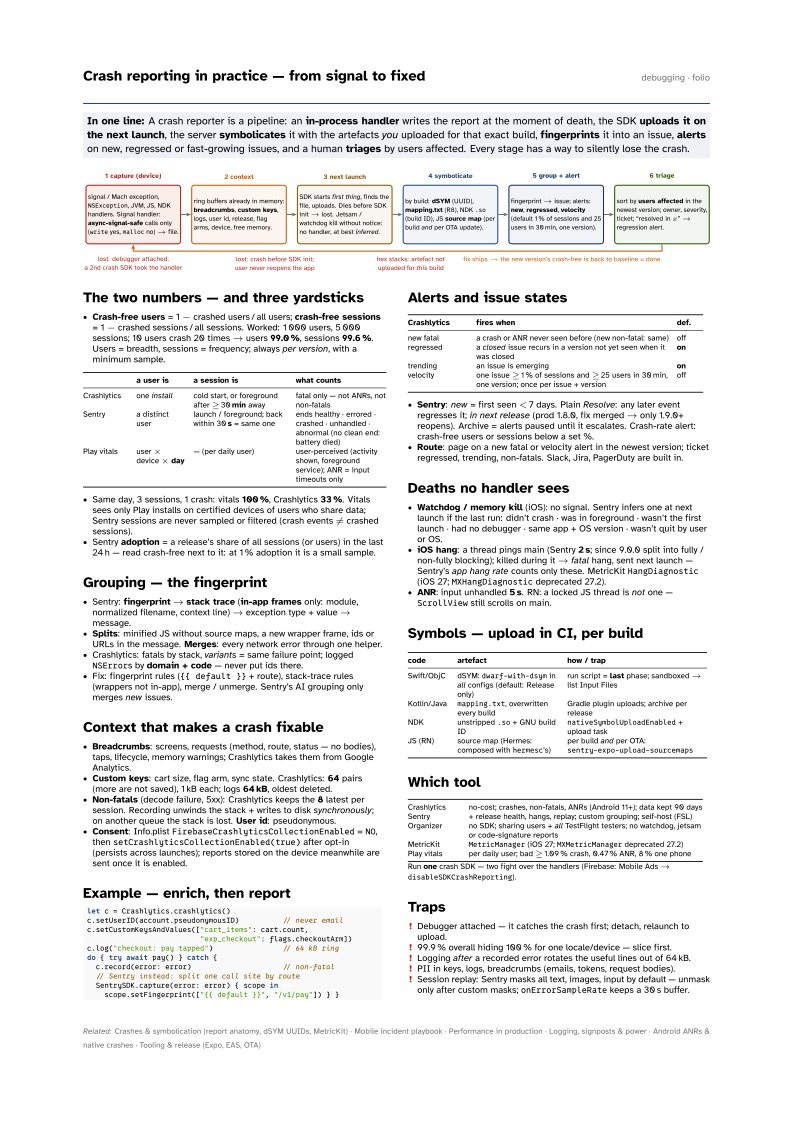
In one line: A crash reporter is a pipeline: an in-process handler writes the
report at the moment of death, the SDK uploads it on the next launch, the
server symbolicates it with the artefacts you uploaded for that exact
build, fingerprints it into an issue, alerts on new, regressed or
fast-growing issues, and a human triages by users affected. Every stage has a
way to silently lose the crash.
user-perceived (activity shown, foreground service); ANR = input timeouts only
Same day, 3 sessions, 1 crash: vitals 100 %, Crashlytics 33 %. Vitals sees only Play installs on certified devices of users who share data; Sentry sessions are never sampled or filtered (crash events ≠ crashed sessions).
Sentry adoption = a release’s share of all sessions (or users) in the last 24 h — read crash-free next to it: at 1 % adoption it is a small sample.
Grouping — the fingerprint
Sentry: fingerprint→stack trace (in-app frames only: module, normalized filename, context line) → exception type + value → message.
Splits: minified JS without source maps, a new wrapper frame, ids or URLs in the message. Merges: every network error through one helper.
Crashlytics: fatals by stack, variants = same failure point; logged NSErrors by domain + code — never put ids there.
Fix: fingerprint rules ({{ default }} + route), stack-trace rules (wrappers not in-app), merge / unmerge. Sentry’s AI grouping only merges new issues.
Context that makes a crash fixable
Breadcrumbs: screens, requests (method, route, status — no bodies), taps, lifecycle, memory warnings; Crashlytics takes them from Google Analytics.
Custom keys: cart size, flag arm, sync state. Crashlytics: 64 pairs (more are not saved), 1 kB each; logs 64 kB, oldest deleted.
Non-fatals (decode failure, 5xx): Crashlytics keeps the 8 latest per session. Recording unwinds the stack + writes to disk synchronously; on another queue the stack is lost. User id: pseudonymous.
Consent: Info.plist FirebaseCrashlyticsCollectionEnabled = NO, then setCrashlyticsCollectionEnabled(true) after opt-in (persists across launches); reports stored on the device meanwhile are sent once it is enabled.
Example — enrich, then report
let c =Crashlytics.crashlytics()
c.setUserID(account.pseudonymousID) // never email
c.setCustomKeysAndValues(["cart_items": cart.count,
"exp_checkout": flags.checkoutArm])
c.log("checkout: pay tapped") // 64 kB ringdo { tryawait pay() } catch {
c.record(error: error) // non-fatal// Sentry instead: split one call site by routeSentrySDK.capture(error: error) { scope in
scope.setFingerprint(["{{ default }}", "/v1/pay"]) } }
Alerts and issue states
Crashlytics
fires when
def.
new fatal
a crash or ANR never seen before (new non-fatal: same)
off
regressed
a closed issue recurs in a version not yet seen when it was closed
on
trending
an issue is emerging
on
velocity
one issue ≥ 1 % of sessions and ≥ 25 users in 30 min, one version; once per issue + version
off
Sentry: new = first seen < 7 days. Plain Resolve: any later event regresses it; in next release (prod 1.8.0, fix merged → only 1.9.0+ reopens). Archive = alerts paused until it escalates. Crash-rate alert: crash-free users or sessions below a set %.
Route: page on a new fatal or velocity alert in the newest version; ticket regressed, trending, non-fatals. Slack, Jira, PagerDuty are built in.
Deaths no handler sees
Watchdog / memory kill (iOS): no signal. Sentry infers one at next launch if the last run: didn’t crash · was in foreground · wasn’t the first launch · had no debugger · same app + OS version · wasn’t quit by user or OS.
iOS hang: a thread pings main (Sentry 2 s; since 9.0.0 split into fully / non-fully blocking); killed during it →fatal hang, sent next launch — Sentry’s app hang rate counts only these. MetricKit HangDiagnostic (iOS 27; MXHangDiagnostic deprecated 27.2).
ANR: input unhandled 5 s. RN: a locked JS thread is not one — ScrollView still scrolls on main.
Symbols — upload in CI, per build
code
artefact
how / trap
Swift/ObjC
dSYM: dwarf-with-dsym in all configs (default: Release only)
run script = last phase; sandboxed → list Input Files
Kotlin/Java
mapping.txt, overwritten every build
Gradle plugin uploads; archive per release
NDK
unstripped .so + GNU build ID
nativeSymbolUploadEnabled + upload task
JS (RN)
source map (Hermes: composed with hermesc’s)
per build and per OTA: sentry-expo-upload-sourcemaps
Which tool
Crashlytics
no-cost; crashes, non-fatals, ANRs (Android 11+); data kept 90 days