
engineering · folio
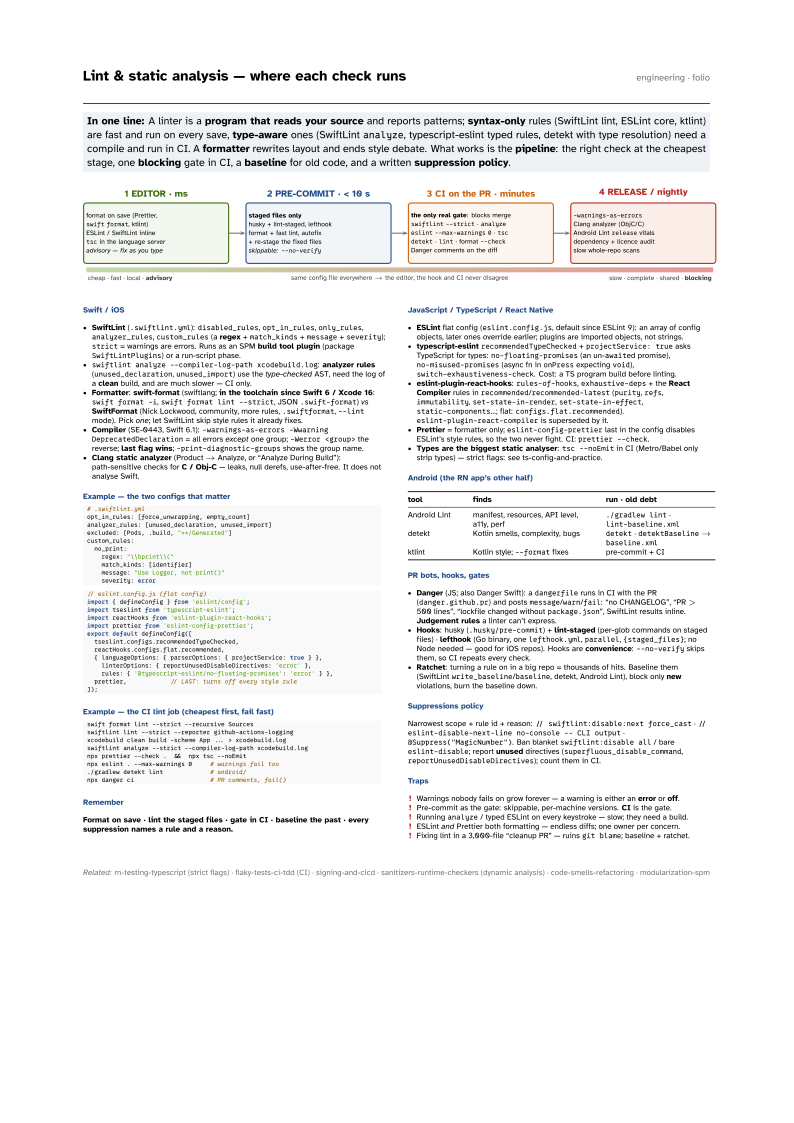
In one line: A linter is a program that reads your source and reports patterns;
syntax-only rules (SwiftLint lint, ESLint core, ktlint) are fast and run on every save,
type-aware ones (SwiftLint analyze, typescript-eslint typed rules, detekt with type
resolution) need a compile and run in CI. A formatter rewrites layout and ends style
debate. What works is the pipeline: the right check at the cheapest stage, one
blocking gate in CI, a baseline for old code, and a written suppression policy.
Download PDF Print view LaTeX source

Swift / iOS
- SwiftLint (
.swiftlint.yml):disabled_rules,opt_in_rules,only_rules,analyzer_rules,custom_rules(a regex +match_kinds+message+severity);strict= warnings are errors. Runs as an SPM build tool plugin (packageSwiftLintPlugins) or a run-script phase. swiftlint analyze --compiler-log-path xcodebuild.log: analyzer rules (unused_declaration,unused_import) use the type-checked AST, need the log of a clean build, and are much slower — CI only.- Formatter: swift-format (swiftlang; in the toolchain since Swift 6 /
Xcode 16:
swift format -i,swift format lint --strict, JSON.swift-format) vs SwiftFormat (Nick Lockwood, community, more rules,.swiftformat,--lintmode). Pick one; let SwiftLint skip style rules it already fixes. - Compiler (SE-0443, Swift 6.1):
-warnings-as-errors -Wwarning
 DeprecatedDeclaration
= all errors except one group;-Werror <group>the reverse; last flag wins;-print-diagnostic-groupsshows the group name. - Clang static analyzer (Product → Analyze, or “Analyze During Build”): path-sensitive checks for C / Obj-C — leaks, null derefs, use-after-free. It does not analyse Swift.
Example — the two configs that matter
# .swiftlint.yml
opt_in_rules: [force_unwrapping, empty_count]
analyzer_rules: [unused_declaration, unused_import]
excluded: [Pods, .build, "**/Generated"]
custom_rules:
  no_print:
    regex: "\\bprint\\("
    match_kinds: [identifier]
    message: "Use Logger, not print()"
    severity: error
// eslint.config.js (flat config)
import { defineConfig } from 'eslint/config';
import tseslint from 'typescript-eslint';
import reactHooks from 'eslint-plugin-react-hooks';
import prettier from 'eslint-config-prettier';
export default defineConfig([
tseslint.configs.recommendedTypeChecked,
reactHooks.configs.flat.recommended,
{ languageOptions: { parserOptions: { projectService: true } },
linterOptions: { reportUnusedDisableDirectives: 'error' },
rules: { '@typescript-eslint/no-floating-promises': 'error' } },
prettier, // LAST: turns off every style rule
]);Example — the CI lint job (cheapest first, fail fast)
swift format lint --strict --recursive Sources
swiftlint lint --strict --reporter github-actions-logging
xcodebuild clean build -scheme App ... > xcodebuild.log
swiftlint analyze --strict --compiler-log-path xcodebuild.log
npx prettier --check .  &&  npx tsc --noEmit
npx eslint . --max-warnings 0     # warnings fail too
./gradlew detekt lint             # android/
npx danger ci                     # PR comments, fail()
Remember
Format on save · lint the staged files · gate in CI · baseline the past · every suppression names a rule and a reason.
JavaScript / TypeScript / React Native
- ESLint flat config (
eslint.config.js, default since ESLint 9): an array of config objects, later ones override earlier; plugins are imported objects, not strings. - typescript-eslint
recommendedTypeChecked+projectService: trueasks TypeScript for types:no-floating-promises(an un-awaited promise),no-misused-promises(async fn inonPressexpectingvoid),switch-exhaustiveness-check. Cost: a TS program build before linting. - eslint-plugin-react-hooks:
rules-of-hooks,exhaustive-deps+ the React Compiler rules inrecommended/recommended-latest(purity,refs,immutability,set-state-in-render,set-state-in-effect,static-components…; flat:configs.flat.recommended).eslint-plugin-react-compileris superseded by it. - Prettier = formatter only;
eslint-config-prettierlast in the config disables ESLint’s style rules, so the two never fight. CI:prettier --check. - Types are the biggest static analyser:
tsc --noEmitin CI (Metro/Babel only strip types) — strict flags: see ts-config-and-practice.
Android (the RN app’s other half)
| tool | finds | run · old debt |
|---|---|---|
| Android Lint | manifest, resources, API level, a11y, perf | ./gradlew lint · lint-baseline.xml |
| detekt | Kotlin smells, complexity, bugs | detekt · detektBaseline → baseline.xml |
| ktlint | Kotlin style; --format fixes | pre-commit + CI |
PR bots, hooks, gates
- Danger (JS; also Danger Swift): a
dangerfileruns in CI with the PR (danger.github.pr) and postsmessage/warn/fail: “no CHANGELOG”, “PR > 500 lines”, “lockfile changed withoutpackage.json”, SwiftLint results inline. Judgement rules a linter can’t express. - Hooks: husky (
.husky/pre-commit) + lint-staged (per-glob commands on staged files) · lefthook (Go binary, onelefthook.yml,parallel,{staged_files}; no Node needed — good for iOS repos). Hooks are convenience:--no-verifyskips them, so CI repeats every check. - Ratchet: turning a rule on in a big repo = thousands of hits. Baseline them (SwiftLint
write_baseline/baseline, detekt, Android Lint), block only new violations, burn the baseline down.
Suppressions policy
Narrowest scope + rule id + reason: // swiftlint:disable:next force_cast · // eslint-disable-next-line no-console -- CLI output · @Suppress("MagicNumber"). Ban blanket swiftlint:disable all / bare eslint-disable; report unused directives (superfluous_disable_command, reportUnusedDisableDirectives); count them in CI.
Traps
- Warnings nobody fails on grow forever — a warning is either an error or off.
- Pre-commit as the gate: skippable, per-machine versions. CI is the gate.
- Running
analyze/ typed ESLint on every keystroke — slow; they need a build. - ESLint and Prettier both formatting — endless diffs; one owner per concern.
- Fixing lint in a 3,000-file “cleanup PR” — ruins
git blame; baseline + ratchet.