
ios-platform · folio
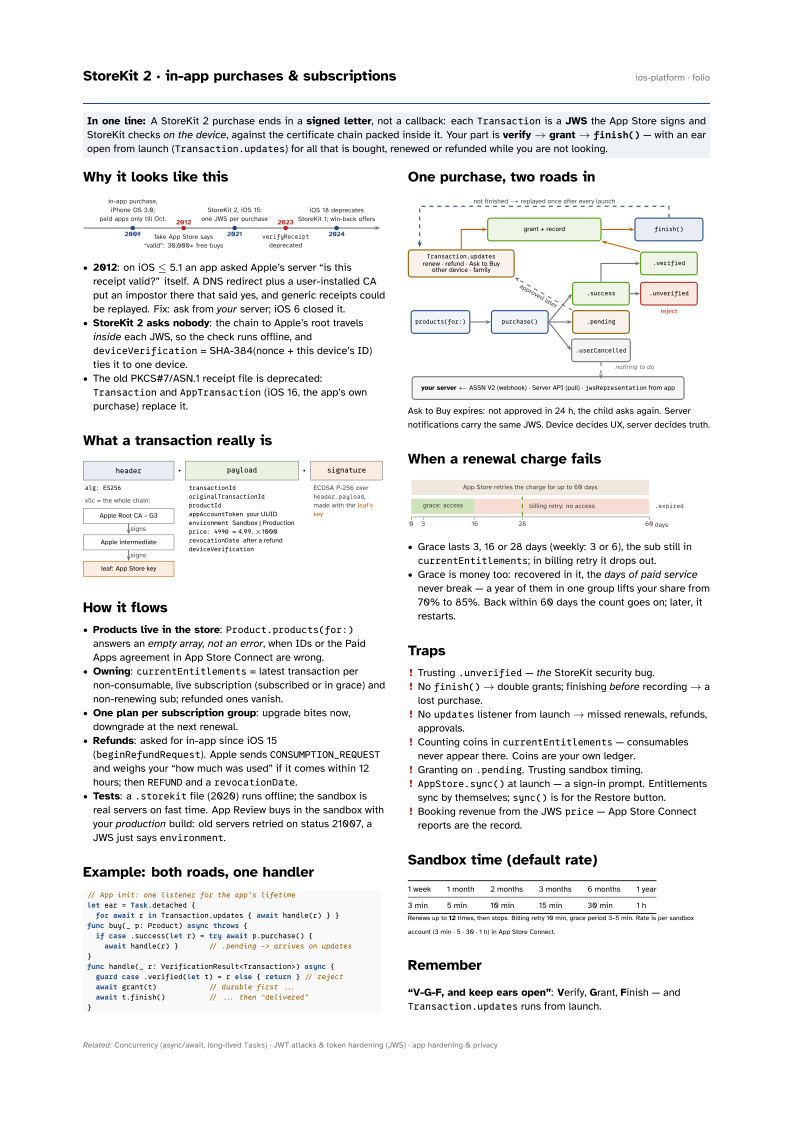
In one line: A StoreKit 2 purchase ends in a signed letter, not a callback:
each Transaction is a JWS the App Store signs and StoreKit
checks on the device, against the certificate chain packed inside it.
Your part is verify → grant → finish() — with an ear
open from launch (Transaction.updates) for all that is bought, renewed
or refunded while you are not looking.
Download PDF Print view LaTeX source
Why it looks like this

- 2012: on iOS ≤ 5.1 an app asked Apple’s server “is this receipt valid?” itself. A DNS redirect plus a user-installed CA put an impostor there that said yes, and generic receipts could be replayed. Fix: ask from your server; iOS 6 closed it.
- StoreKit 2 asks nobody: the chain to Apple’s root travels inside each JWS, so the check runs offline, and
deviceVerification= SHA-384(nonce + this device’s ID) ties it to one device. - The old PKCS#7/ASN.1 receipt file is deprecated:
TransactionandAppTransaction(iOS 16, the app’s own purchase) replace it.
What a transaction really is

How it flows
- Products live in the store:
Product.products(for:)answers an empty array, not an error, when IDs or the Paid Apps agreement in App Store Connect are wrong. - Owning:
currentEntitlements= latest transaction per non-consumable, live subscription (subscribed or in grace) and non-renewing sub; refunded ones vanish. - One plan per subscription group: upgrade bites now, downgrade at the next renewal.
- Refunds: asked for in-app since iOS 15 (
beginRefundRequest). Apple sendsCONSUMPTION_REQUESTand weighs your “how much was used” if it comes within 12 hours; thenREFUNDand arevocationDate. - Tests: a
.storekitfile (2020) runs offline; the sandbox is real servers on fast time. App Review buys in the sandbox with your production build: old servers retried on status 21007, a JWS just saysenvironment.
Example: both roads, one handler
// App init: one listener for the app's lifetime
let ear = Task.detached {
  for await r in Transaction.updates { await handle(r) } }
func buy(_ p: Product) async throws {
  if case .success(let r) = try await p.purchase() {
    await handle(r) }       // .pending -> arrives on updates
}
func handle(_ r: VerificationResult<Transaction>) async {
  guard case .verified(let t) = r else { return } // reject
  await grant(t)            // durable first ...
  await t.finish()          // ... then "delivered"
}
One purchase, two roads in

Ask to Buy expires: not approved in 24 h, the child asks again. Server notifications carry the same JWS. Device decides UX, server decides truth.
When a renewal charge fails

- Grace lasts 3, 16 or 28 days (weekly: 3 or 6), the sub still in
currentEntitlements; in billing retry it drops out. - Grace is money too: recovered in it, the days of paid service never break — a year of them in one group lifts your share from 70% to 85%. Back within 60 days the count goes on; later, it restarts.
Traps
- Trusting
.unverified— the StoreKit security bug. - No
finish()→ double grants; finishing before recording → a lost purchase. - No
updateslistener from launch → missed renewals, refunds, approvals. - Counting coins in
currentEntitlements— consumables never appear there. Coins are your own ledger. - Granting on
.pending. Trusting sandbox timing. AppStore.sync()at launch — a sign-in prompt. Entitlements sync by themselves;sync()is for the Restore button.- Booking revenue from the JWS
price— App Store Connect reports are the record.
Sandbox time (default rate)
| 1 week | 1 month | 2 months | 3 months | 6 months | 1 year |
|---|---|---|---|---|---|
| 3 min | 5 min | 10 min | 15 min | 30 min | 1 h |
Renews up to 12 times, then stops. Billing retry 10 min, grace period 3–5 min. Rate is per sandbox account (3 min · 5 · 30 · 1 h) in App Store Connect.
Remember
“V-G-F, and keep ears open”: Verify, Grant, Finish — and Transaction.updates runs from launch.
Further reading
- Meet StoreKit 2 (WWDC21) — the design from the people who built it: why JWS, why the chain rides inside, and device verification done by hand
- In-App Purchase Receipt Validation for iOS 5.1 and Earlier — Apple’s own retired note on the 2012 fake-App-Store hole, still online
- Verifying JWTs from Apple’s App Store — walking the x5c chain by hand, without Apple’s library: what “verified” actually checks
- Support customers and handle refunds (WWDC21) — the refund flow from the inside: the in-app request sheet and the 12-hour consumption window
- Reducing involuntary subscriber churn — grace period vs billing retry, and what to show the user in each