
javascript · folio
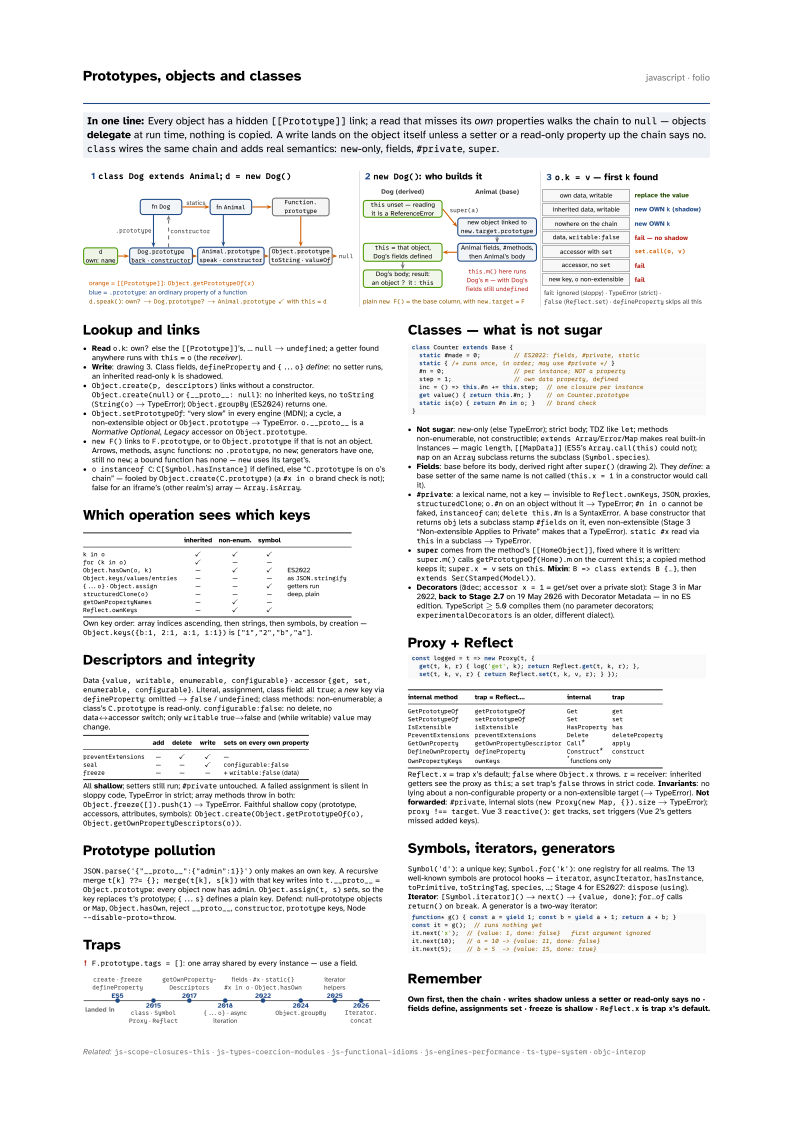
In one line: Every object has a hidden [[Prototype]] link; a read that misses its own
properties walks the chain to null — objects delegate at run time, nothing is
copied. A write lands on the object itself unless a setter or a read-only property up the chain
says no. class wires the same chain and adds real semantics: new-only, fields,
#private, super.
Download PDF Print view LaTeX source

Lookup and links
- Read
o.k: own? else the[[Prototype]]’s, …null→undefined; a getter found anywhere runs withthis=o(the receiver). - Write: drawing 3. Class fields,
definePropertyand{...o}define: no setter runs, an inherited read-onlykis shadowed. Object.create(p, descriptors)links without a constructor.Object.create(null)or{__proto__: null}: no inherited keys, notoString(String(o)→ TypeError);Object.groupBy(ES2024) returns one.Object.setPrototypeOf: “very slow” in every engine (MDN); a cycle, a non-extensible object orObject.prototype→ TypeError.o.__proto__is a Normative Optional, Legacy accessor onObject.prototype.new F()links toF.prototype, or toObject.prototypeif that is not an object. Arrows, methods,asyncfunctions: no.prototype, nonew; generators have one, still nonew; a bound function has none —newuses its target’s.o instanceof C:C[Symbol.hasInstance]if defined, else “C.prototypeis ono’s chain” — fooled byObject.create(C.prototype)(a#x in obrand check is not); false for an iframe’s (other realm’s) array —Array.isArray.
Which operation sees which keys
| inherited | non-enum. | symbol | ||
|---|---|---|---|---|
k in o | ✓ | ✓ | ✓ | |
for (k in o) | ✓ | — | — | |
Object.hasOwn(o, k) | — | ✓ | ✓ | ES2022 |
Object.keys/values/entries | — | — | — | as JSON.stringify |
{...o} · Object.assign | — | — | ✓ | getters run |
structuredClone(o) | — | — | — | deep, plain |
getOwnPropertyNames | — | ✓ | — | |
Reflect.ownKeys | — | ✓ | ✓ |
Object.keys({b:1, 2:1, a:1, 1:1}) is ["1","2","b","a"].
Descriptors and integrity
Data {value, writable, enumerable, configurable} · accessor {get, set, enumerable,
configurable}. Literal, assignment, class field: all true; a new key via defineProperty: omitted → false / undefined; class methods: non-enumerable; a class’s C.prototype is read-only. configurable:false: no delete, no data↔accessor switch; only writable true→false and (while writable) value may change.
| add | delete | write | sets on every own property | |
|---|---|---|---|---|
preventExtensions | — | ✓ | ✓ | — |
seal | — | — | ✓ | configurable:false |
freeze | — | — | — | + writable:false (data) |
#private untouched. A failed assignment is silent in sloppy code, TypeError in strict; array methods throw in both: Object.freeze([]).push(1) → TypeError. Faithful shallow copy (prototype, accessors, attributes, symbols): Object.create(Object.getPrototypeOf(o), Object.getOwnPropertyDescriptors(o)).
Prototype pollution
JSON.parse('{"__proto__":{"admin":1}}') only makes an own key. A recursive merge t[k] ??= {}; merge(t[k], s[k]) with that key writes into t.__proto__ = Object.prototype: every object now has admin. Object.assign(t, s) sets, so the key replaces t’s prototype; {...s} defines a plain key. Defend: null-prototype objects or Map, Object.hasOwn, reject __proto__, constructor, prototype keys, Node --disable-proto=throw.
Traps
F.prototype.tags = []: one array shared by every instance — use a field.

Classes — what is not sugar
class Counter extends Base {
  static #made = 0;         // ES2022: fields, #private, static
  static { /* runs once, in order; may use #private */ }
  #n = 0;                   // per instance; NOT a property
  step = 1;                 // own data property, defined
  inc = () => this.#n += this.step;  // one closure per instance
  get value() { return this.#n; }    // on Counter.prototype
  static is(o) { return #n in o; }   // brand check
}- Not sugar:
new-only (else TypeError); strict body; TDZ likelet; methods non-enumerable, not constructible;extends Array/Error/Mapmakes real built-in instances — magiclength,[[MapData]](ES5’sArray.call(this)could not);mapon anArraysubclass returns the subclass (Symbol.species). - Fields: base before its body, derived right after
super()(drawing 2). They define: a base setter of the same name is not called (this.x = 1in a constructor would call it). #private: a lexical name, not a key — invisible toReflect.ownKeys,JSON, proxies,structuredClone;o.#non an object without it → TypeError;#n in ocannot be faked,instanceofcan;delete this.#nis a SyntaxError. A base constructor that returnsobjlets a subclass stamp#fieldson it, even non-extensible (Stage 3 “Non-extensible Applies to Private” makes that a TypeError).static #xread viathisin a subclass → TypeError.supercomes from the method’s[[HomeObject]], fixed where it is written:super.m()callsgetPrototypeOf(Home).mon the currentthis; a copied method keeps it;super.x = vsets onthis. Mixin:B => class extends B {…}, thenextends Ser(Stamped(Model)).- Decorators (
@dec;accessor x = 1= get/set over a private slot): Stage 3 in Mar 2022, back to Stage 2.7 on 19 May 2026 with Decorator Metadata — in no ES edition. TypeScript ≥ 5.0 compiles them (no parameter decorators;experimentalDecoratorsis an older, different dialect).
Proxy + Reflect
const logged = t => new Proxy(t, {
  get(t, k, r) { log('get', k); return Reflect.get(t, k, r); },
  set(t, k, v, r) { return Reflect.set(t, k, v, r); } });
internal method | trap = Reflect.… | internal | trap |
|---|---|---|---|
GetPrototypeOf | getPrototypeOf | Get | get |
SetPrototypeOf | setPrototypeOf | Set | set |
IsExtensible | isExtensible | HasProperty | has |
PreventExtensions | preventExtensions | Delete | deleteProperty |
GetOwnProperty | getOwnPropertyDescriptor | Call* | apply |
DefineOwnProperty | defineProperty | Construct* | construct |
OwnPropertyKeys | ownKeys | *functions only | |
Reflect.x = trap x’s default; false where Object.x throws. r = receiver: inherited getters see the proxy as this; a set trap’s false throws in strict code. Invariants: no lying about a non-configurable property or a non-extensible target (→ TypeError). Not forwarded: #private, internal slots (new Proxy(new Map, {}).size → TypeError); proxy !== target. Vue 3 reactive(): get tracks, set triggers (Vue 2’s getters missed added keys).
Symbols, iterators, generators
Symbol('d'): a unique key; Symbol.for('k'): one registry for all realms. The 13 well-known symbols are protocol hooks — iterator, asyncIterator, hasInstance, toPrimitive, toStringTag, species, …; Stage 4 for ES2027: dispose (using). Iterator: [Symbol.iterator]() → next() → {value, done}; for…of calls return() on break. A generator is a two-way iterator:
function* g() { const a = yield 1; const b = yield a + 1; return a + b; }
const it = g();  // runs nothing yet
it.next('x');  // {value: 1, done: false}   first argument ignored
it.next(10);   // a = 10 -> {value: 11, done: false}
it.next(5);    // b = 5  -> {value: 15, done: true}
Remember
Own first, then the chain · writes shadow unless a setter or read-only says no · fields
define, assignments set · freeze is shallow · Reflect.x is trap x’s default.