
javascript · folio
In one line: Seven primitive types (immutable, by value) + Object (by identity). Implicit
conversions are built from ToPrimitive, ToNumber, ToString,
ToBoolean, so every “WAT” traces. ES modules link the whole graph before
any code runs and imports are live bindings; require runs a file and returns an object.
Download PDF Print view LaTeX source
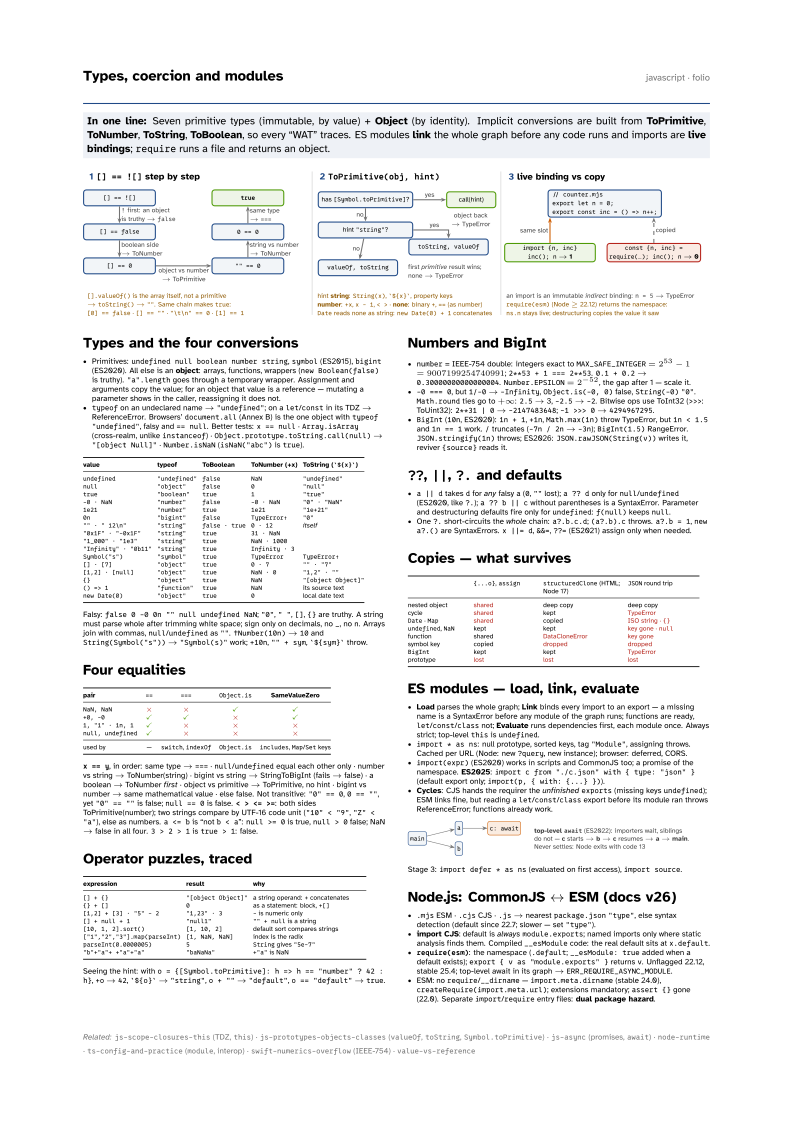

Types and the four conversions
- Primitives:
undefined null boolean number string,symbol(ES2015),bigint(ES2020). All else is an object: arrays, functions, wrappers (new Boolean(false)is truthy)."a".lengthgoes through a temporary wrapper. Assignment and arguments copy the value; for an object that value is a reference — mutating a parameter shows in the caller, reassigning it does not. typeofon an undeclared name →"undefined"; on alet/constin its TDZ → ReferenceError. Browsers’document.all(Annex B) is the one object withtypeof"undefined", falsy and== null. Better tests:x == null·Array.isArray(cross-realm, unlikeinstanceof) ·Object.prototype.toString.call(null)→"[object Null]"·Number.isNaN(isNaN("abc")istrue).
value | typeof | ToBoolean | ToNumber (+x) | ToString ( |
|---|---|---|---|---|
undefined | "undefined" | false | NaN | "undefined" |
null | "object" | false | 0 | "null" |
true | "boolean" | true | 1 | "true" |
-0 · NaN | "number" | false | -0 · NaN | "0" · "NaN" |
1e21 | "number" | true | 1e21 | "1e+21" |
0n | "bigint" | false | TypeError† | "0" |
"" · " 12\n" | "string" | false · true | 0 · 12 | itself |
"0x1F" · "-0x1F" | "string" | true | 31 · NaN | |
"1_000" · "1e3" | "string" | true | NaN · 1000 | |
"Infinity" · "0b11" | "string" | true | Infinity · 3 | |
Symbol("s") | "symbol" | true | TypeError | TypeError† |
[] · [7] | "object" | true | 0 · 7 | "" · "7" |
[1,2] · [null] | "object" | true | NaN · 0 | "1,2" · "" |
{} | "object" | true | NaN | "[object Object]" |
() => 1 | "function" | true | NaN | its source text |
new Date(0) | "object" | true | 0 | local date text |
Falsy: false 0 -0 0n "" null undefined NaN; "0", " ", [], {} are truthy. A string must parse whole after trimming white space; sign only on decimals, no _, no n. Arrays join with commas, null/undefined as "". †Number(10n) → 10 and String(Symbol("s")) → "Symbol(s)" work; +10n, "" + sym, `${sym}` throw.
Four equalities
pair | == | === | Object.is | SameValueZero |
|---|---|---|---|---|
NaN, NaN | × | × | ✓ | ✓ |
+0, -0 | ✓ | ✓ | × | ✓ |
1, "1" · 1n, 1 | ✓ | × | × | × |
null, undefined | ✓ | × | × | × |
used by | — | switch, indexOf | Object.is | includes, Map/Set keys |
x == y, in order: same type → === · null/undefined equal each other only · number vs string → ToNumber(string) · bigint vs string → StringToBigInt (fails → false) · a boolean → ToNumber first · object vs primitive → ToPrimitive, no hint · bigint vs number → same mathematical value · else false. Not transitive: "0" == 0, 0 == "", yet "0" == "" is false; null == 0 is false. < > <= >=: both sides ToPrimitive(number); two strings compare by UTF-16 code unit ("10" < "9", "Z" < "a"), else as numbers. a <= b is “not b < a”: null >= 0 is true, null > 0 false; NaN → false in all four. 3 > 2 > 1 is true > 1: false.
Operator puzzles, traced
expression | result | why |
|---|---|---|
[] + {} | "[object Object]" | a string operand: + concatenates |
{} + [] | 0 | as a statement: block, +[] |
[1,2] + [3] · "5" - 2 | "1,23" · 3 | - is numeric only |
[] + null + 1 | "null1" | "" + null is a string |
[10, 1, 2].sort() | [1, 10, 2] | default sort compares strings |
["1","2","3"].map(parseInt) | [1, NaN, NaN] | index is the radix |
parseInt(0.0000005) | 5 | String gives "5e-7" |
"b"+"a"+ +"a"+"a" | "baNaNa" | +"a" is NaN |
Seeing the hint: with o = {[Symbol.toPrimitive]: h => h == "number" ? 42 : h}, +o → 42, `${o}` → "string", o + "" → "default", o == "default" → true.
Numbers and BigInt
number= IEEE-754 double: integers exact toMAX_SAFE_INTEGER= 253-1 = 9007199254740991;2**53 + 1 === 2**53.0.1 + 0.2→0.30000000000000004.Number.EPSILON= 2-52, the gap after 1 — scale it.-0 === 0, but1/-0→-Infinity,Object.is(-0, 0)false,String(-0)"0".Math.roundties go to +∞:2.5→ 3,-2.5→-2. Bitwise ops use ToInt32 (>>>: ToUint32):2**31 | 0→-2147483648;-1 >>> 0→4294967295.BigInt(10n, ES2020):1n + 1,+1n,Math.max(1n)throw TypeError, but1n < 1.5and1n == 1work./truncates (-7n / 2n→-3n);BigInt(1.5)RangeError.JSON.stringify(1n)throws; ES2026:JSON.rawJSON(String(v))writes it, reviver{source}reads it.
??, ||, ?. and defaults
a || dtakesdfor any falsya(0,""lost);a ?? donly fornull/undefined(ES2020, like?.);a ?? b || cwithout parentheses is a SyntaxError. Parameter and destructuring defaults fire only forundefined:f(null)keepsnull.- One
?.short-circuits the whole chain:a?.b.c.d;(a?.b).cthrows.a?.b = 1,new a?.()are SyntaxErrors.x ||= d,&&=,??=(ES2021) assign only when needed.
Copies — what survives
{...o}, assign | structuredClone (HTML; Node 17) | JSON round trip | |
|---|---|---|---|
| nested object | shared | deep copy | deep copy |
| cycle | shared | kept | TypeError |
Date · Map | shared | copied | ISO string · {} |
undefined, NaN | kept | kept | key gone · null |
| function | shared | DataCloneError | key gone |
| symbol key | copied | dropped | dropped |
BigInt | kept | kept | TypeError |
| prototype | lost | lost | lost |
ES modules — load, link, evaluate
- Load parses the whole graph; Link binds every import to an export — a missing name is a SyntaxError before any module of the graph runs; functions are ready,
let/const/classnot; Evaluate runs dependencies first, each module once. Always strict; top-levelthisisundefined. import * as ns: null prototype, sorted keys, tag"Module", assigning throws. Cached per URL (Node: new?query, new instance); browser: deferred, CORS.import(expr)(ES2020) works in scripts and CommonJS too; a promise of the namespace. ES2025:import c from "./c.json" with { type: "json" }(default export only;import(p, { with: {...} })).- Cycles: CJS hands the requirer the unfinished
exports(missing keysundefined); ESM links fine, but reading alet/const/classexport before its module ran throws ReferenceError; functions already work.

Stage 3: import defer * as ns (evaluated on first access), import source.
Node.js: CommonJS ↔ ESM (docs v26)
.mjsESM ·.cjsCJS ·.js→ nearestpackage.json"type", else syntax detection (default since 22.7; slower — set"type").- import CJS: default is always
module.exports; named imports only where static analysis finds them. Compiled__esModulecode: the real default sits atx.default. require(esm): the namespace (.default;__esModule: trueadded when a default exists);export { v as "module.exports" }returnsv. Unflagged 22.12, stable 25.4; top-level await in its graph →ERR_REQUIRE_ASYNC_MODULE.- ESM: no
require/__dirname—import.meta.dirname(stable 24.0),createRequire(import.meta.url); extensions mandatory;assert {}gone (22.0). Separateimport/requireentry files: dual package hazard.