
react-native · folio
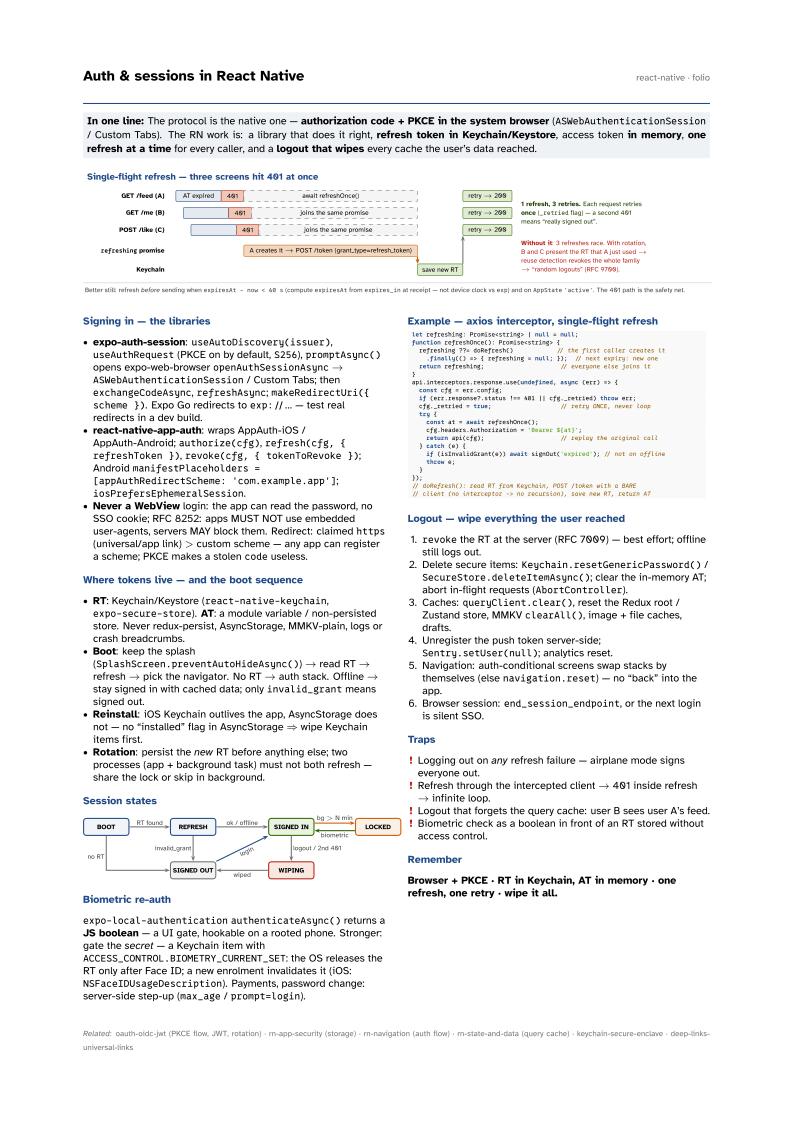
In one line: The protocol is the native one — authorization code + PKCE in the system browser
(ASWebAuthenticationSession / Custom Tabs). The RN work is: a library that does it right,
refresh token in Keychain/Keystore, access token in memory, one refresh at a
time for every caller, and a logout that wipes every cache the user’s data reached.
Download PDF Print view LaTeX source

Signing in — the libraries
- expo-auth-session:
useAutoDiscovery(issuer),useAuthRequest(PKCE on by default,S256),promptAsync()opens expo-web-browseropenAuthSessionAsync→ASWebAuthenticationSession/ Custom Tabs; thenexchangeCodeAsync,refreshAsync;makeRedirectUri({ scheme }). Expo Go redirects toexp://… — test real redirects in a dev build. - react-native-app-auth: wraps AppAuth-iOS / AppAuth-Android;
authorize(cfg),refresh(cfg, { refreshToken }),revoke(cfg, { tokenToRevoke }); AndroidmanifestPlaceholders = [appAuthRedirectScheme: 'com.example.app'];iosPrefersEphemeralSession. - Never a WebView login: the app can read the password, no SSO cookie; RFC 8252: apps MUST NOT use embedded user-agents, servers MAY block them. Redirect: claimed
https(universal/app link) > custom scheme — any app can register a scheme; PKCE makes a stolencodeuseless.
Where tokens live — and the boot sequence
- RT: Keychain/Keystore (
react-native-keychain,expo-secure-store). AT: a module variable / non-persisted store. Never redux-persist, AsyncStorage, MMKV-plain, logs or crash breadcrumbs. - Boot: keep the splash (
SplashScreen.preventAutoHideAsync()) → read RT → refresh → pick the navigator. No RT → auth stack. Offline → stay signed in with cached data; onlyinvalid_grantmeans signed out. - Reinstall: iOS Keychain outlives the app, AsyncStorage does not — no “installed” flag in AsyncStorage ⇒ wipe Keychain items first.
- Rotation: persist the new RT before anything else; two processes (app + background task) must not both refresh — share the lock or skip in background.
Session states

Biometric re-auth
expo-local-authentication authenticateAsync() returns a JS boolean — a UI gate, hookable on a rooted phone. Stronger: gate the secret — a Keychain item with ACCESS_CONTROL.BIOMETRY_CURRENT_SET: the OS releases the RT only after Face ID; a new enrolment invalidates it (iOS: NSFaceIDUsageDescription). Payments, password change: server-side step-up (max_age / prompt=login).
Example — axios interceptor, single-flight refresh
let refreshing: Promise<string> | null = null;
function refreshOnce(): Promise<string> {
  refreshing ??= doRefresh()            // the first caller creates it
    .finally(() => { refreshing = null; });  // next expiry: new one
  return refreshing;                     // everyone else joins it
}
api.interceptors.response.use(undefined, async (err) => {
  const cfg = err.config;
  if (err.response?.status !== 401 || cfg._retried) throw err;
  cfg._retried = true;                   // retry ONCE, never loop
  try {
    const at = await refreshOnce();
    cfg.headers.Authorization = `Bearer ${at}`;
    return api(cfg);                     // replay the original call
  } catch (e) {
    if (isInvalidGrant(e)) await signOut('expired'); // not on offline
    throw e;
  }
});
// doRefresh(): read RT from Keychain, POST /token with a BARE
// client (no interceptor -> no recursion), save new RT, return AT
Logout — wipe everything the user reached
revokethe RT at the server (RFC 7009) — best effort; offline still logs out.- Delete secure items:
Keychain.resetGenericPassword()/SecureStore.deleteItemAsync(); clear the in-memory AT; abort in-flight requests (AbortController). - Caches:
queryClient.clear(), reset the Redux root / Zustand store, MMKVclearAll(), image + file caches, drafts. - Unregister the push token server-side;
Sentry.setUser(null); analytics reset. - Navigation: auth-conditional screens swap stacks by themselves (else
navigation.reset) — no “back” into the app. - Browser session:
end_session_endpoint, or the next login is silent SSO.
Traps
- Logging out on any refresh failure — airplane mode signs everyone out.
- Refresh through the intercepted client → 401 inside refresh → infinite loop.
- Logout that forgets the query cache: user B sees user A’s feed.
- Biometric check as a boolean in front of an RT stored without access control.