
recall · folio
In one line: the exact values, case lists and call orders that UIKit, Foundation, SwiftUI and the test frameworks fix by definition, and the names that patterns and principles were given by their authors — each checked against Apple’s documentation, the Swift Book or the originator. The why behind each lives in the linked folios.
Download PDF Print view LaTeX source
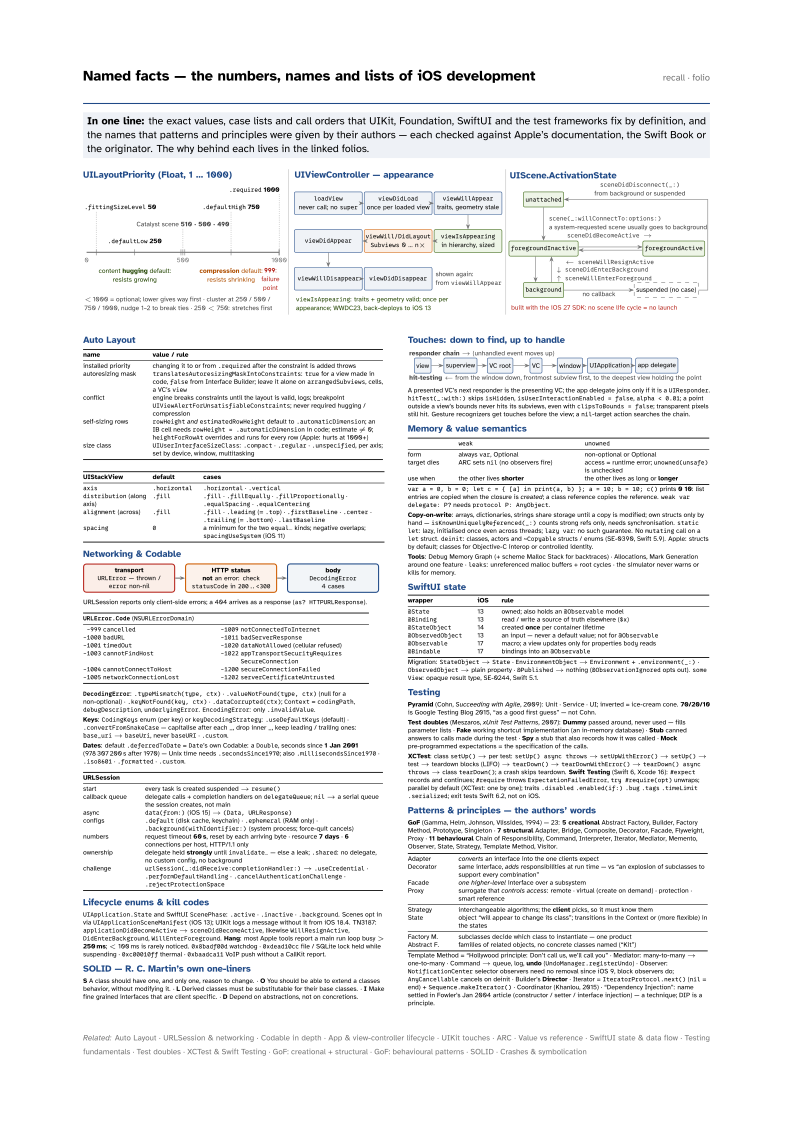

Auto Layout
| name | value / rule |
|---|---|
| installed priority | changing it to or from .required after the constraint is added throws |
| autoresizing mask | translatesAutoresizingMaskIntoConstraints: true for a view made in code, false from Interface Builder; leave it alone on arrangedSubviews, cells, a VC’s view |
| conflict | engine breaks constraints until the layout is valid, logs; breakpoint UIViewAlertForUnsatisfiableConstraints; never required hugging / compression |
| self-sizing rows | rowHeight and estimatedRowHeight default to .automaticDimension; an IB cell needs rowHeight = .automaticDimension in code; estimate ≠ 0; heightForRowAt overrides and runs for every row (Apple: hurts at 1000+) |
| size class | UIUserInterfaceSizeClass: .compact · .regular · .unspecified, per axis; set by device, window, multitasking |
| UIStackView | default | cases |
|---|---|---|
axis | .horizontal | .horizontal · .vertical |
distribution (along axis) | .fill | .fill · .fillEqually · .fillProportionally · .equalSpacing · .equalCentering |
alignment (across) | .fill | .fill · .leading (= .top) · .firstBaseline · .center · .trailing (= .bottom) · .lastBaseline |
spacing | 0 | a minimum for the two equal… kinds; negative overlaps; spacingUseSystem (iOS 11) |
Networking & Codable

URLSession reports only client-side errors; a 404 arrives as a response
(as? HTTPURLResponse).
URLError.Code (NSURLErrorDomain) | |||
|---|---|---|---|
-999 | cancelled | -1009 | notConnectedToInternet |
-1000 | badURL | -1011 | badServerResponse |
-1001 | timedOut | -1020 | dataNotAllowed (cellular refused) |
-1003 | cannotFindHost | -1022 | appTransportSecurityRequiresSecureConnection |
-1004 | cannotConnectToHost | -1200 | secureConnectionFailed |
-1005 | networkConnectionLost | -1202 | serverCertificateUntrusted |
DecodingError: .typeMismatch(type, ctx) · .valueNotFound(type, ctx) (null for
a non-optional) · .keyNotFound(key, ctx) · .dataCorrupted(ctx); Context =
codingPath, debugDescription, underlyingError. EncodingError: only
.invalidValue.
Keys: CodingKeys enum (per key) or keyDecodingStrategy: .useDefaultKeys
(default) · .convertFromSnakeCase — capitalise after each _, drop inner _, keep
leading / trailing ones: base_uri → baseUri, never baseURI · .custom.
Dates: default .deferredToDate = Date’s own Codable: a Double, seconds since
1 Jan 2001 (978 307 200 s after 1970) — Unix time needs .secondsSince1970;
also .millisecondsSince1970 · .iso8601 · .formatted · .custom.
| URLSession | |
|---|---|
| start | every task is created suspended → resume() |
| callback queue | delegate calls + completion handlers on delegateQueue; nil → a serial queue the session creates, not main |
| async | data(from:) (iOS 15) → (Data, URLResponse) |
| configs | .default (disk cache, keychain) · .ephemeral (RAM only) · .background(withIdentifier:) (system process; force-quit cancels) |
| numbers | request timeout 60 s, reset by each arriving byte · resource 7 days · 6 connections per host, HTTP/1.1 only |
| ownership | delegate held strongly until invalidate… — else a leak; .shared: no delegate, no custom config, no background |
| challenge | urlSession(_:didReceive:completionHandler:) → .useCredential · .performDefaultHandling · .cancelAuthenticationChallenge · .rejectProtectionSpace |
Lifecycle enums & kill codes
UIApplication.State and SwiftUI ScenePhase: .active · .inactive ·
.background. Scenes opt in via UIApplicationSceneManifest (iOS 13); UIKit logs a message
without it from iOS 18.4. TN3187: applicationDidBecomeActive → sceneDidBecomeActive, likewise
WillResignActive, DidEnterBackground, WillEnterForeground. Hang: most Apple
tools report a main run loop busy > 250 ms; < 100 ms is rarely noticed. 0x8badf00d watchdog
· 0xdead10cc file / SQLite lock held while suspending · 0xc00010ff thermal ·
0xbaadca11 VoIP push without a CallKit report.
SOLID — R. C. Martin’s own one-liners
S A class should have one, and only one, reason to change. · O You should be able to extend a classes behavior, without modifying it. · L Derived classes must be substitutable for their base classes. · I Make fine grained interfaces that are client specific. · D Depend on abstractions, not on concretions.
Touches: down to find, up to handle

A presented VC’s next responder is the presenting VC; the app delegate joins only if it
is a UIResponder. hitTest(_:with:) skips isHidden, isUserInteractionEnabled = false,
alpha < 0.01; a point outside a view’s bounds never hits its subviews, even with
clipsToBounds = false; transparent pixels still hit. Gesture recognizers get touches before the
view; a nil-target action searches the chain.
Memory & value semantics
weak | unowned | |
|---|---|---|
| form | always var, Optional | non-optional or Optional |
| target dies | ARC sets nil (no observers fire) | access = runtime error; unowned(unsafe) is unchecked |
| use when | the other lives shorter | the other lives as long or longer |
var a = 0, b = 0; let c = { [a] in print(a, b) }; a = 10; b = 10; c() prints 0 10: list
entries are copied when the closure is created; a class reference copies the reference.
weak var delegate: P? needs protocol P: AnyObject.
Copy-on-write: arrays, dictionaries, strings share storage until a copy is modified; own
structs only by hand — isKnownUniquelyReferenced(_:) counts strong refs only, needs
synchronisation. static let: lazy, initialised once even across threads; lazy var: no
such guarantee. No mutating call on a let struct. deinit: classes, actors and
~Copyable structs / enums (SE-0390, Swift 5.9). Apple: structs by default;
classes for Objective-C interop or controlled identity.
Tools: Debug Memory Graph (+ scheme Malloc Stack for backtraces) · Allocations, Mark
Generation around one feature · leaks: unreferenced malloc buffers + root cycles · the simulator
never warns or kills for memory.
SwiftUI state
| wrapper | iOS | rule |
|---|---|---|
@State | 13 | owned; also holds an @Observable model |
@Binding | 13 | read / write a source of truth elsewhere ($x) |
@StateObject | 14 | created once per container lifetime |
@ObservedObject | 13 | an input — never a default value; not for @Observable |
@Observable | 17 | macro; a view updates only for properties body reads |
@Bindable | 17 | bindings into an @Observable |
StateObject → State · EnvironmentObject → Environment +
.environment(_:) · ObservedObject → plain property · @Published → nothing
(@ObservationIgnored opts out). some View: opaque result type, SE-0244, Swift 5.1.
Testing
Pyramid (Cohn, Succeeding with Agile, 2009): Unit · Service · UI; inverted =
ice-cream cone. 70/20/10 is Google Testing Blog 2015, “as a good first guess” — not Cohn. Test doubles (Meszaros, xUnit Test Patterns, 2007): Dummy passed
around, never used — fills parameter lists · Fake working shortcut implementation (an
in-memory database) · Stub canned answers to calls made during the test · Spy a stub
that also records how it was called · Mock pre-programmed expectations = the specification of
the calls. XCTest: class setUp() → per test: setUp() async throws → setUpWithError()
→ setUp() → test → teardown blocks (LIFO) → tearDown() → tearDownWithError() →
tearDown() async throws → class tearDown(); a crash skips teardown. Swift Testing
(Swift 6, Xcode 16): #expect records and continues; #require throws
ExpectationFailedError, try #require(opt) unwraps; parallel by default (XCTest: one by
one); traits .disabled .enabled(if:) .bug .tags .timeLimit .serialized;
exit tests Swift 6.2, not on iOS.
Patterns & principles — the authors’ words
GoF (Gamma, Helm, Johnson, Vlissides, 1994) — 23: 5 creational Abstract Factory, Builder, Factory Method, Prototype, Singleton · 7 structural Adapter, Bridge, Composite, Decorator, Facade, Flyweight, Proxy · 11 behavioural Chain of Responsibility, Command, Interpreter, Iterator, Mediator, Memento, Observer, State, Strategy, Template Method, Visitor.
| Adapter | converts an interface into the one clients expect |
| Decorator | same interface, adds responsibilities at run time — vs “an explosion of subclasses to support every combination” |
| Facade | one higher-level interface over a subsystem |
| Proxy | surrogate that controls access: remote · virtual (create on demand) · protection · smart reference |
| Strategy | interchangeable algorithms; the client picks, so it must know them |
| State | object “will appear to change its class”; transitions in the Context or (more flexible) in the states |
| Factory M. | subclasses decide which class to instantiate — one product |
| Abstract F. | families of related objects, no concrete classes named (“Kit”) |
UndoManager.registerUndo) ·
Observer: NotificationCenter selector observers need no removal since iOS 9, block observers do;
AnyCancellable cancels on deinit · Builder’s Director · Iterator =
IteratorProtocol.next() (nil = end) + Sequence.makeIterator() · Coordinator
(Khanlou, 2015) · “Dependency Injection”: name settled in Fowler’s Jan 2004 article (constructor /
setter / interface injection) — a technique; DIP is a principle.