
security · folio
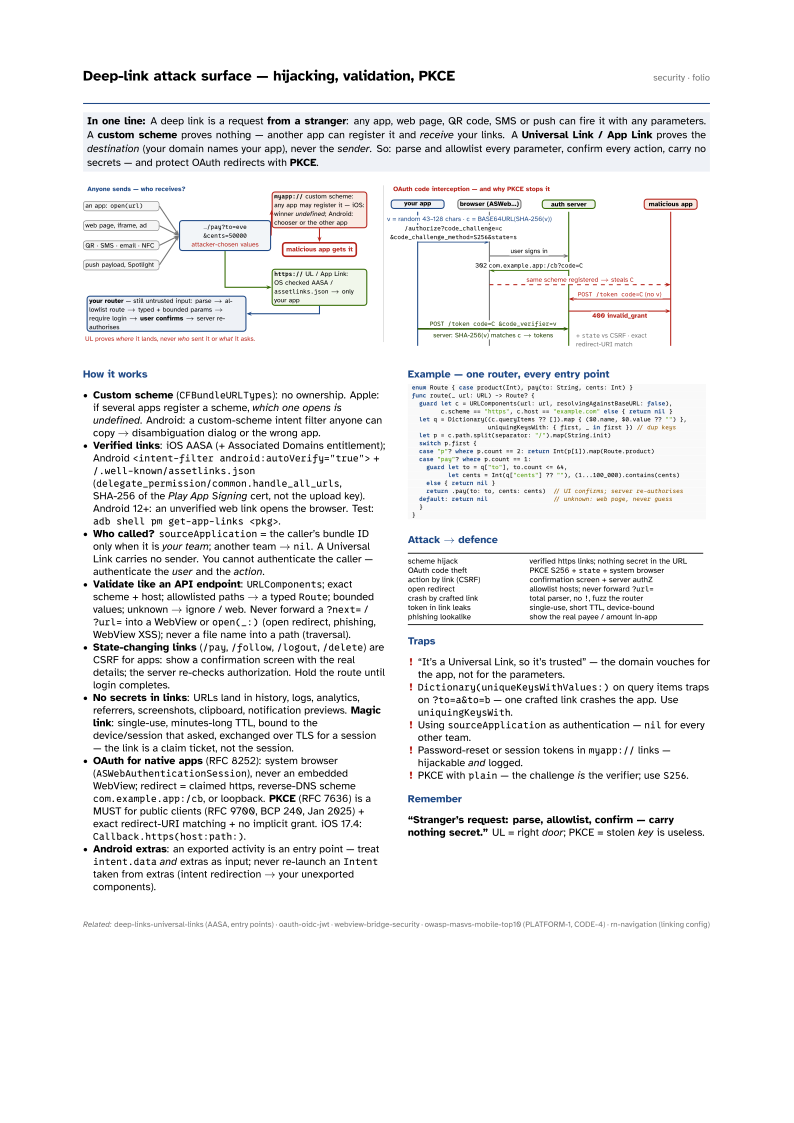
In one line: A deep link is a request from a stranger: any app, web page, QR code, SMS or push can fire it with any parameters. A custom scheme proves nothing — another app can register it and receive your links. A Universal Link / App Link proves the destination (your domain names your app), never the sender. So: parse and allowlist every parameter, confirm every action, carry no secrets — and protect OAuth redirects with PKCE.
Download PDF Print view LaTeX source

How it works
- Custom scheme (
CFBundleURLTypes): no ownership. Apple: if several apps register a scheme, which one opens is undefined. Android: a custom-scheme intent filter anyone can copy → disambiguation dialog or the wrong app. - Verified links: iOS AASA (+ Associated Domains entitlement); Android
<intent-filter android:autoVerify="true">+/.well-known/assetlinks.json(delegate_permission/common.handle_all_urls, SHA-256 of the Play App Signing cert, not the upload key). Android 12+: an unverified web link opens the browser. Test:adb shell pm get-app-links <pkg>. - Who called?
sourceApplication= the caller’s bundle ID only when it is your team; another team →nil. A Universal Link carries no sender. You cannot authenticate the caller — authenticate the user and the action. - Validate like an API endpoint:
URLComponents; exact scheme + host; allowlisted paths → a typedRoute; bounded values; unknown → ignore / web. Never forward a?next=/?url=into a WebView oropen(_:)(open redirect, phishing, WebView XSS); never a file name into a path (traversal). - State-changing links (
/pay,/follow,/logout,/delete) are CSRF for apps: show a confirmation screen with the real details; the server re-checks authorization. Hold the route until login completes. - No secrets in links: URLs land in history, logs, analytics, referrers, screenshots, clipboard, notification previews. Magic link: single-use, minutes-long TTL, bound to the device/session that asked, exchanged over TLS for a session — the link is a claim ticket, not the session.
- OAuth for native apps (RFC 8252): system browser (
ASWebAuthenticationSession), never an embedded WebView; redirect = claimed https, reverse-DNS schemecom.example.app:/cb, or loopback. PKCE (RFC 7636) is a MUST for public clients (RFC 9700, BCP 240, Jan 2025) + exact redirect-URI matching + no implicit grant. iOS 17.4:Callback.https(host:path:). - Android extras: an exported activity is an entry point — treat
intent.dataand extras as input; never re-launch anIntenttaken from extras (intent redirection → your unexported components).
Example — one router, every entry point
enum Route { case product(Int), pay(to: String, cents: Int) }
func route(_ url: URL) -> Route? {
  guard let c = URLComponents(url: url, resolvingAgainstBaseURL: false),
        c.scheme == "https", c.host == "example.com" else { return nil }
  let q = Dictionary((c.queryItems ?? []).map { ($0.name, $0.value ?? "") },
                     uniquingKeysWith: { first, _ in first }) // dup keys
  let p = c.path.split(separator: "/").map(String.init)
  switch p.first {
  case "p"? where p.count == 2: return Int(p[1]).map(Route.product)
  case "pay"? where p.count == 1:
    guard let to = q["to"], to.count <= 64,
          let cents = Int(q["cents"] ?? ""), (1...100_000).contains(cents)
    else { return nil }
    return .pay(to: to, cents: cents)  // UI confirms; server re-authorises
  default: return nil                  // unknown: web page, never guess
  }
}
Attack → defence
| scheme hijack | verified https links; nothing secret in the URL |
| OAuth code theft | PKCE S256 + state + system browser |
| action by link (CSRF) | confirmation screen + server authZ |
| open redirect | allowlist hosts; never forward ?url= |
| crash by crafted link | total parser, no !, fuzz the router |
| token in link leaks | single-use, short TTL, device-bound |
| phishing lookalike | show the real payee / amount in-app |
Traps
- “It’s a Universal Link, so it’s trusted” — the domain vouches for the app, not for the parameters.
Dictionary(uniqueKeysWithValues:)on query items traps on?to=a&to=b— one crafted link crashes the app. UseuniquingKeysWith.- Using
sourceApplicationas authentication —nilfor every other team. - Password-reset or session tokens in
myapp://links — hijackable and logged. - PKCE with
plain— the challenge is the verifier; useS256.
Remember
“Stranger’s request: parse, allowlist, confirm — carry nothing secret.” UL = right door; PKCE = stolen key is useless.