
security · folio
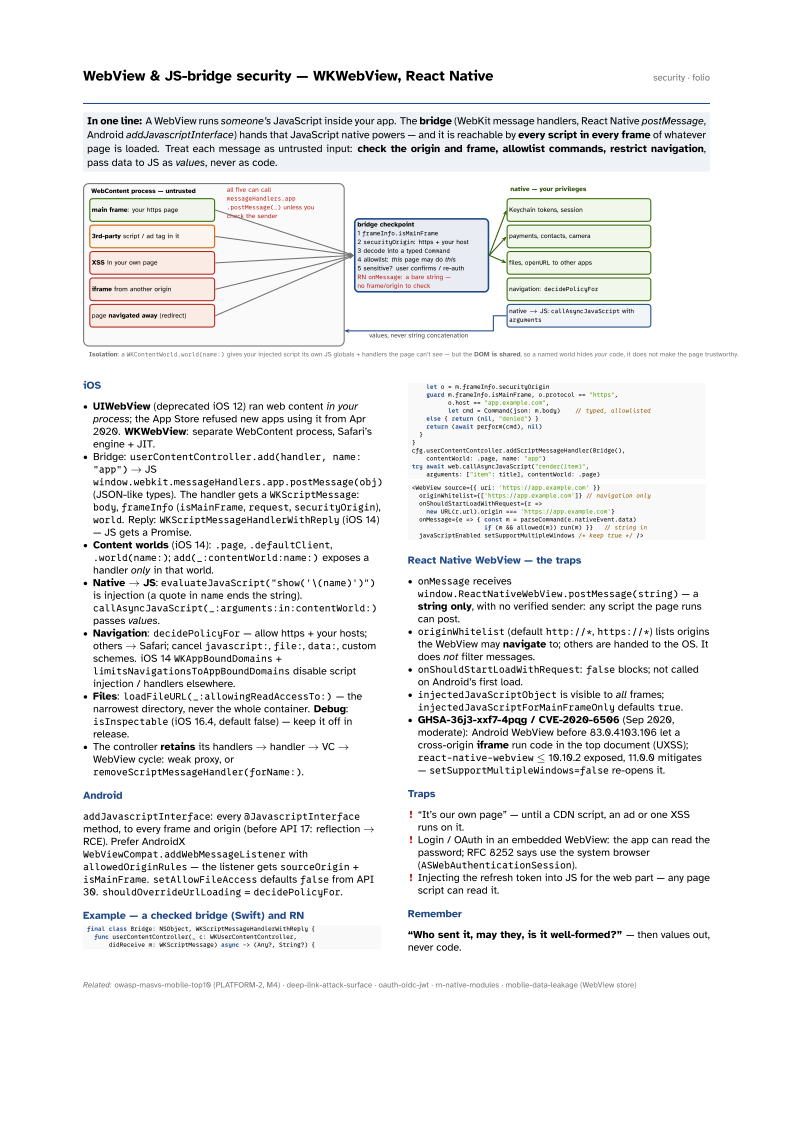
In one line: A WebView runs someone’s JavaScript inside your app. The bridge (WebKit message handlers, React Native postMessage, Android addJavascriptInterface) hands that JavaScript native powers — and it is reachable by every script in every frame of whatever page is loaded. Treat each message as untrusted input: check the origin and frame, allowlist commands, restrict navigation, pass data to JS as values, never as code.
Download PDF Print view LaTeX source

iOS
- UIWebView (deprecated iOS 12) ran web content in your process; the App Store refused new apps using it from Apr 2020. WKWebView: separate WebContent process, Safari’s engine + JIT.
- Bridge:
userContentController.add(handler, name: "app")→ JSwindow.webkit.messageHandlers.app.postMessage(obj)(JSON-like types). The handler gets aWKScriptMessage:body,frameInfo(isMainFrame,request,securityOrigin),world. Reply:WKScriptMessageHandlerWithReply(iOS 14) — JS gets a Promise. - Content worlds (iOS 14):
.page,.defaultClient,.world(name:);add(_:contentWorld:name:)exposes a handler only in that world. - Native → JS:
evaluateJavaScript("show('\(name)')")is injection (a quote innameends the string).callAsyncJavaScript(_:arguments:in:contentWorld:)passes values. - Navigation:
decidePolicyFor— allow https + your hosts; others → Safari; canceljavascript:,file:,data:, custom schemes. iOS 14WKAppBoundDomains+limitsNavigationsToAppBoundDomainsdisable script injection / handlers elsewhere. - Files:
loadFileURL(_:allowingReadAccessTo:)— the narrowest directory, never the whole container. Debug:isInspectable(iOS 16.4, default false) — keep it off in release. - The controller retains its handlers → handler → VC → WebView cycle: weak proxy, or
removeScriptMessageHandler(forName:).
Android
addJavascriptInterface: every @JavascriptInterface method, to every frame and origin (before API 17: reflection → RCE). Prefer AndroidX WebViewCompat.addWebMessageListener with allowedOriginRules — the listener gets sourceOrigin + isMainFrame. setAllowFileAccess defaults false from API 30. shouldOverrideUrlLoading = decidePolicyFor.
Example — a checked bridge (Swift) and RN
final class Bridge: NSObject, WKScriptMessageHandlerWithReply {
  func userContentController(_ c: WKUserContentController,
      didReceive m: WKScriptMessage) async -> (Any?, String?) {
    let o = m.frameInfo.securityOrigin
    guard m.frameInfo.isMainFrame, o.protocol == "https",
          o.host == "app.example.com",
          let cmd = Command(json: m.body)    // typed, allowlisted
    else { return (nil, "denied") }
    return (await perform(cmd), nil)
  }
}
cfg.userContentController.addScriptMessageHandler(Bridge(),
    contentWorld: .page, name: "app")
try await web.callAsyncJavaScript("render(item)",
arguments: ["item": title], contentWorld: .page)<WebView source={{ uri: 'https://app.example.com' }}
originWhitelist={['https://app.example.com']} // navigation only
onShouldStartLoadWithRequest={r =>
new URL(r.url).origin === 'https://app.example.com'}
onMessage={e => { const m = parseCommand(e.nativeEvent.data)
if (m && allowed(m)) run(m) }} // string in
javaScriptEnabled setSupportMultipleWindows /* keep true */ />React Native WebView — the traps
onMessagereceiveswindow.ReactNativeWebView.postMessage(string)— a string only, with no verified sender: any script the page runs can post.originWhitelist(defaulthttp://*,https://*) lists origins the WebView may navigate to; others are handed to the OS. It does not filter messages.onShouldStartLoadWithRequest:falseblocks; not called on Android’s first load.injectedJavaScriptObjectis visible to all frames;injectedJavaScriptForMainFrameOnlydefaultstrue.- GHSA-36j3-xxf7-4pqg / CVE-2020-6506 (Sep 2020, moderate): Android WebView before 83.0.4103.106 let a cross-origin iframe run code in the top document (UXSS);
react-native-webview≤ 10.10.2 exposed, 11.0.0 mitigates —setSupportMultipleWindows=falsere-opens it.
Traps
- “It’s our own page” — until a CDN script, an ad or one XSS runs on it.
- Login / OAuth in an embedded WebView: the app can read the password; RFC 8252 says use the system browser (
ASWebAuthenticationSession). - Injecting the refresh token into JS for the web part — any page script can read it.
Remember
“Who sent it, may they, is it well-formed?” — then values out, never code.