
typescript · folio
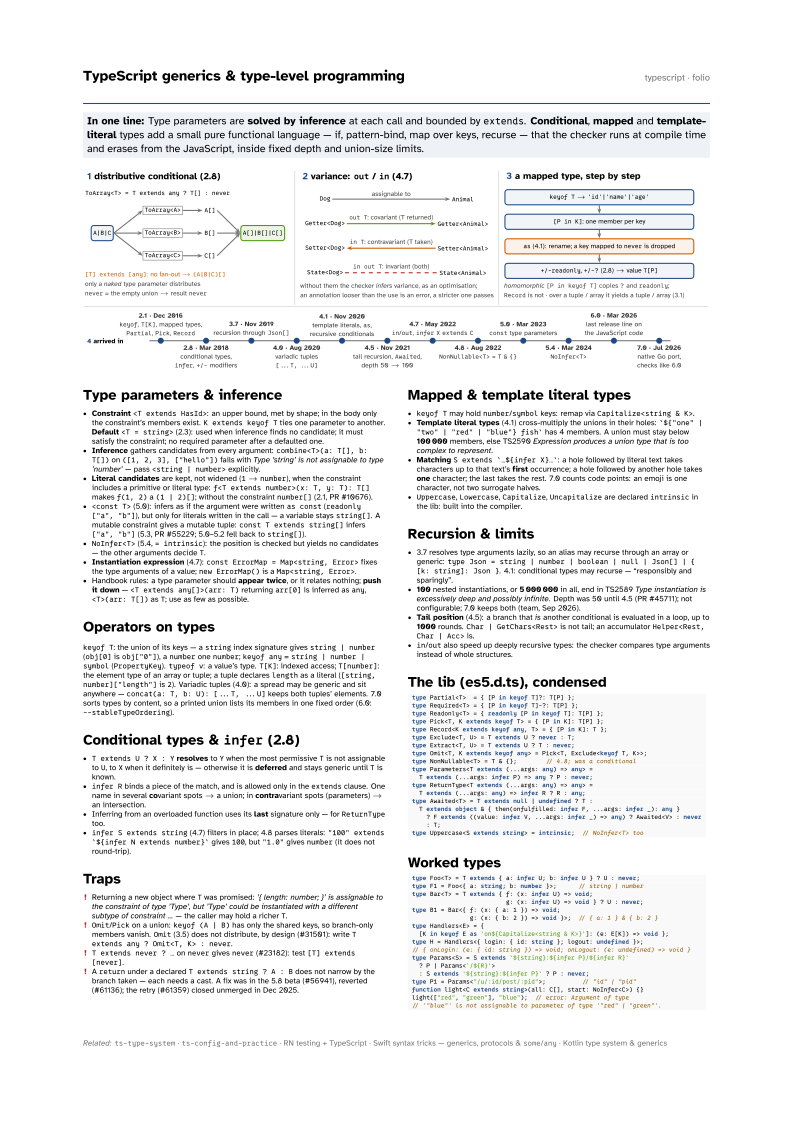
In one line: Type parameters are solved by inference at each call and bounded by
extends. Conditional, mapped and template-literal types add a
small pure functional language — if, pattern-bind, map over keys, recurse — that the checker runs
at compile time and erases from the JavaScript, inside fixed depth and union-size limits.
Download PDF Print view LaTeX source

Type parameters & inference
- Constraint
<T extends HasId>: an upper bound, met by shape; in the body only the constraint’s members exist.K extends keyof Tties one parameter to another. Default<T = string>(2.3): used when inference finds no candidate; it must satisfy the constraint; no required parameter after a defaulted one. - Inference gathers candidates from every argument:
combine<T>(a: T[], b: T[])on([1, 2, 3], ["hello"])fails with Type ’string’ is not assignable to type ’number’ — pass<string | number>explicitly. - Literal candidates are kept, not widened (
1→number), when the constraint includes a primitive or literal type:f<T extends number>(x: T, y: T): T[]makesf(1, 2)a(1 | 2)[]; without the constraintnumber[](2.1, PR #10676). <const T>(5.0): infers as if the argument were writtenas const(readonly ["a", "b"]), but only for literals written in the call — a variable staysstring[]. A mutable constraint gives a mutable tuple:const T extends string[]infers["a", "b"](5.3, PR #55229; 5.0–5.2 fell back tostring[]).NoInfer<T>(5.4,= intrinsic): the position is checked but yields no candidates — the other arguments decideT.- Instantiation expression (4.7):
const ErrorMap = Map<string, Error>fixes the type arguments of a value;new ErrorMap()is aMap<string, Error>. - Handbook rules: a type parameter should appear twice, or it relates nothing; push it down —
<T extends any[]>(arr: T)returningarr[0]is inferred asany,<T>(arr: T[])asT; use as few as possible.
Operators on types
keyof T: the union of its keys — a string index signature gives string | number (obj[0] is obj["0"]), a number one number; keyof any = string | number | symbol (PropertyKey). typeof v: a value’s type. T[K]: indexed access; T[number]: the element type of an array or tuple; a tuple declares length as a literal ([string, number]["length"] is 2). Variadic tuples (4.0): a spread may be generic and sit anywhere — concat(a: T, b: U): [...T, ...U] keeps both tuples’ elements. 7.0 sorts types by content, so a printed union lists its members in one fixed order (6.0: --stableTypeOrdering).
Conditional types & infer (2.8)
T extends U ? X : Yresolves toYwhen the most permissiveTis not assignable toU, toXwhen it definitely is — otherwise it is deferred and stays generic untilTis known.infer Rbinds a piece of the match, and is allowed only in theextendsclause. One name in several covariant spots → a union; in contravariant spots (parameters) → an intersection.- Inferring from an overloaded function uses its last signature only — for
ReturnTypetoo. infer S extends string(4.7) filters in place; 4.8 parses literals:"100" extends `${infer N extends number}`gives100, but"1.0"givesnumber(it does not round-trip).
Traps
- Returning a new object where
Twas promised: ’{ length: number; }’ is assignable to the constraint of type ’Type’, but ’Type’ could be instantiated with a different subtype of constraint … — the caller may hold a richerT. Omit/Pickon a union:keyof (A | B)has only the shared keys, so branch-only members vanish.Omit(3.5) does not distribute, by design (#31501): writeT extends any ? Omit<T, K> : never.T extends never ? …onnevergivesnever(#23182): test[T] extends [never].- A
returnunder a declaredT extends string ? A : Bdoes not narrow by the branch taken — each needs a cast. A fix was in the 5.8 beta (#56941), reverted (#61136); the retry (#61359) closed unmerged in Dec 2025.
Mapped & template literal types
keyof Tmay holdnumber/symbolkeys: remap viaCapitalize<string & K>.- Template literal types (4.1) cross-multiply the unions in their holes:
`${"one" | "two" | "red" | "blue"} fish`has 4 members. A union must stay below 100 000 members, else TS2590 Expression produces a union type that is too complex to represent. - Matching
S extends `…${infer X}…`: a hole followed by literal text takes characters up to that text’s first occurrence; a hole followed by another hole takes one character; the last takes the rest. 7.0 counts code points: an emoji is one character, not two surrogate halves. Uppercase,Lowercase,Capitalize,Uncapitalizeare declaredintrinsicin the lib: built into the compiler.
Recursion & limits
- 3.7 resolves type arguments lazily, so an alias may recurse through an array or generic:
type Json = string | number | boolean | null | Json[] | { [k: string]: Json }. 4.1: conditional types may recurse — “responsibly and sparingly”. - 100 nested instantiations, or 5 000 000 in all, end in TS2589 Type instantiation is excessively deep and possibly infinite. Depth was 50 until 4.5 (PR #45711); not configurable; 7.0 keeps both (team, Sep 2026).
- Tail position (4.5): a branch that is another conditional is evaluated in a loop, up to 1000 rounds.
Char | GetChars<Rest>is not tail; an accumulatorHelper<Rest, Char | Acc>is. in/outalso speed up deeply recursive types: the checker compares type arguments instead of whole structures.
The lib (es5.d.ts), condensed
type Partial<T>  = { [P in keyof T]?: T[P] };
type Required<T> = { [P in keyof T]-?: T[P] };
type Readonly<T> = { readonly [P in keyof T]: T[P] };
type Pick<T, K extends keyof T> = { [P in K]: T[P] };
type Record<K extends keyof any, T> = { [P in K]: T };
type Exclude<T, U> = T extends U ? never : T;
type Extract<T, U> = T extends U ? T : never;
type Omit<T, K extends keyof any> = Pick<T, Exclude<keyof T, K>>;
type NonNullable<T> = T & {};        // 4.8; was a conditional
type Parameters<T extends (...args: any) => any> =
  T extends (...args: infer P) => any ? P : never;
type ReturnType<T extends (...args: any) => any> =
  T extends (...args: any) => infer R ? R : any;
type Awaited<T> = T extends null | undefined ? T :
  T extends object & { then(onfulfilled: infer F, ...args: infer _): any }
    ? F extends ((value: infer V, ...args: infer _) => any) ? Awaited<V> : never
    : T;
type Uppercase<S extends string> = intrinsic;  // NoInfer<T> too
Worked types
type Foo<T> = T extends { a: infer U; b: infer U } ? U : never;
type F1 = Foo<{ a: string; b: number }>;      // string | number
type Bar<T> = T extends { f: (x: infer U) => void;
                          g: (x: infer U) => void } ? U : never;
type B1 = Bar<{ f: (x: { a: 1 }) => void;
                g: (x: { b: 2 }) => void }>;  // { a: 1 } & { b: 2 }
type Handlers<E> = {
  [K in keyof E as `on${Capitalize<string & K>}`]: (e: E[K]) => void };
type H = Handlers<{ login: { id: string }; logout: undefined }>;
// { onLogin: (e: { id: string }) => void; onLogout: (e: undefined) => void }
type Params<S> = S extends `${string}:${infer P}/${infer R}`
  ? P | Params<`/${R}`>
  : S extends `${string}:${infer P}` ? P : never;
type P1 = Params<"/u/:id/post/:pid">;          // "id" | "pid"
function light<C extends string>(all: C[], start: NoInfer<C>) {}
light(["red", "green"], "blue");  // error: Argument of type
// '"blue"' is not assignable to parameter of type '"red" | "green"'.